





![[FATHER'S DAY] Ember Glow Ticket | $6.68 — Handcrafted Epoxy Resin LED Lamp | Unique Ambient Decor & Collector's Gift](http://rescenestudio.com/cdn/shop/files/Lucky_Star_Ticket_NYE_2026_c61361fc-ea06-4a31-8379-e16ed7d47902.jpg?v=1767177179&width=320)


Reading Nook Lighting: 5 Setups That Actually Work

Most reading nooks fail in the same way. Someone sets up a beautiful armchair near a window, adds a small table and a stack of books, and then plugs in a single bedside-style lamp. Three weeks later, the nook is being used as a coat rack because reading there gives the user a tension headache by chapter three. The chair was right. The lighting was wrong.
This guide covers five specific reading nook lighting setups that actually work. Each one is a complete recipe: the lamp type, the bulb specs, the placement, and the cost range. Pick the one that fits your space and budget. By the end, you'll know exactly what to buy and where to put it so reading there feels good for hours instead of minutes.
Why Most Reading Nook Lighting Fails
The three most common reading nook lighting mistakes are all preventable:
- One small bulb in a single bedside-style lamp. Not enough lumens for sustained reading. Eye strain by minute 20.
- Overhead light only. Light comes from the wrong angle (above and behind), shadowing the page with the reader's own head.
- Cool-white bulbs. Reading is a wind-down activity for most people. Cool white feels clinical and signals "stay alert" rather than "relax."
The fix is surprisingly specific: light needs to come from beside or behind the reader at a 30-45 degree angle, fall on the page from the upper-back direction, hit at 800-1,200 lumens, and use a 2700-3000K warm white bulb. Get those four right and reading feels comfortable for hours.
Setup 1: The Classic Floor Lamp Reading Corner ($80-150)
The standard, hard-to-beat setup for any reading chair. A tall floor lamp positioned behind and slightly to the side of the chair, angled toward the reader's lap. The lamp itself stands roughly 60-65 inches tall (the bottom of the shade should sit just above the reader's shoulder when seated).
What to buy: A standard arc or torchiere floor lamp from West Elm, IKEA, or CB2. Pair with a 800-1,200 lumen LED bulb at 2700K.
Placement: Behind the chair on the side opposite your dominant hand. Tilt the lamp head 30-45 degrees toward your lap. Test: open a book and check that no shadow from your head falls on the page.

Why it works: Floor lamps put the light source above the reader's head from the back, which mimics natural daylight reading conditions. The angle eliminates head-shadow problems and the height keeps the bulb above eye level so glare doesn't hit your eyes when you look up from the page.

Setup 2: The Wall-Mounted Swing-Arm Sconce ($120-250)
Best for renters or anyone with limited floor space. A swing-arm sconce mounts on the wall behind or beside the chair and extends 12-30 inches outward. The arm pivots so you can position the bulb exactly where you need it.
What to buy: Pottery Barn or West Elm both make plug-in versions that don't require electrical work. Choose plug-in if you can't drill into walls; choose hardwired if you own the home and want a clean look.
Placement: Mount 50-55 inches off the floor (just above the reader's shoulder when seated). Position 18-24 inches behind the chair. The pivoting arm lets you fine-tune the angle nightly without re-installing.
Why it works: The swing-arm allows precision placement that fixed lamps don't. The bulb ends up in the optimal "behind and to the side" position for any chair angle.
Setup 3: The Floor + Accent Combo ($150-250)
The setup that feels most like a curated reading corner. A primary floor lamp for reading-specific light, plus a small accent piece on a side table for ambient glow. The floor lamp does the practical job; the accent piece adds atmosphere.
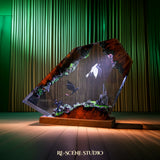
What to buy: Floor lamp as in Setup 1, plus a small handcrafted accent piece on a side table. Resin lamps with warm interior LEDs work well here because they sit at a different height and add a different quality of glow than the floor lamp.

Placement: Floor lamp behind/beside the chair as in Setup 1. Accent piece on a side table at coffee or knee height. The two should be visually distinct (different sizes, different glow qualities).
Why it works: Two light sources at two different heights creates the layered ambient that makes reading nooks feel like cozy hideaways rather than just well-lit corners. The floor lamp does the work; the accent does the atmosphere.
Setup 4: The Bedside Convertible (For Tight Spaces) ($60-100)
If your reading nook is actually a corner of your bedroom, a tall table lamp on a bedside-height table can do double duty. The trick is sizing the lamp larger than a typical bedside lamp so it can serve both reading and ambient use.
What to buy: A 30-32 inch tall table lamp (significantly bigger than the standard 22-26 inch bedside lamp) on a tall side table. The bottom of the shade should sit at sitting-shoulder height. Use an 800+ lumen LED bulb at 2700-3000K.
Placement: On the side table at the level of the chair's arm or slightly higher. The shade height matters more than the lamp's footprint; you can use a smaller table if the lamp is tall enough.
Why it works: A bigger-than-typical table lamp does the job that a floor lamp would do but takes less footprint. Good for studio apartments or bedrooms where a floor lamp would be overkill.
Setup 5: The "I'm Renting and Can't Drill" Setup ($60-120)
For renters or people with strict no-drilling rules. The challenge: get the lamp behind/beside the chair without wall mounting, without a floor lamp footprint that crowds the space.
Solution: A clip-on lamp on the back of a tall bookshelf or chair. Or a tripod floor lamp with a small footprint. Or a height-adjustable architect-style desk lamp clamped to a side table.
What to buy: Architect lamp from BenQ, IKEA, or Amazon. The clamp-on style ($30-60) saves floor space entirely. The tripod floor lamp style ($80-120) adds visual interest without taking much footprint.
Placement: Clamp the lamp to the side table or chair frame. Position the head behind/above where you'd hold a book. The architect-style swivel is the secret weapon: you can adjust nightly.
Why it works: Clamp lamps and architect lamps were originally designed for drafting tables, where precise light positioning matters. The same engineering works for reading.

Bulb Specs That Actually Matter for Reading
Whatever lamp you pick, the bulb inside makes or breaks the reading experience. Three specs to get right:
| Spec | Reading Nook Target | Why |
|---|---|---|
| Lumens | 800-1,200 | Below 600 strains eyes; above 1,500 creates glare on the page |
| Color temp | 2700-3000K | Warm enough to feel relaxing, neutral enough to read clearly |
| CRI (color rendering) | 90+ ideal, 80+ acceptable | Higher CRI makes book text crisper and skin tones natural |
| Dimmable | Yes if possible | Lets you tune brightness to time of day and reading material |
For more on reading the bulb spec sheet without falling for marketing inflation, our guide to wattage, lumens, and Kelvin covers exactly which numbers matter for which application.
Avoiding the Most Common Reading Nook Mistakes
Beyond the lighting setup itself, three setup-killers send reading nooks to the discard pile within weeks:
- The chair is too low for the lamp. A 16-inch-tall ottoman chair paired with a 22-inch bedside lamp puts the bulb below your eyeline. The light hits the page from the wrong direction. Match chair height to lamp shade height.
- The nook is too dark overall. A reading lamp alone in a dark room can cause pupil dilation issues that lead to faster eye fatigue. Add a small ambient source (candle, salt lamp, or an accent piece) so the surrounding room isn't pitch dark.
- The lamp gets used for everything else. If your "reading lamp" doubles as your phone charger and laptop spot, the chair stops being a reading place. Keep the nook lamp for reading only and the cognitive cue holds.
The Reading Nook Layering Principle
Beyond the primary reading light, three smaller layer additions transform the nook from "place to read" to "place I want to read":
- Throw blanket draped over the arm of the chair. Visual texture + functional warmth.
- Small candle or warm accent piece. Provides tonal warmth even when the reading lamp is on.
- One houseplant near the lamp. The lamp light filters through the leaves and creates dappled shadows on the wall behind, which adds visual depth.
The combination is the difference between "I should read more" (and never doing it) and "this is where I read every evening" (and actually doing it).
For broader cozy-room principles, our guide to making any room cozy on a budget covers the layering technique applied to entire rooms, not just nooks.
Frequently Asked Questions
Featured Resin Lamps
Handcrafted with care — each one unique



Every lamp we create carries a piece of our heart — a small universe of light, resin, and imagination, handcrafted in our workshop for someone across the world who shares our love for these stories.