



The Mandalorian Way of the Father: Din Djarin's Dad Arc

The Mandalorian way of the father is not announced. There is no speech where Din Djarin says he loves the kid. There is no flashback explaining why a hardened bounty hunter spends three seasons risking his life for a green toddler he was originally paid to kidnap. The show built its central father-son arc the way real fathers actually build them: through small repeated actions, broken vows, and the slow accumulation of someone you would die for. Forty years after Vader threw his emperor down a reactor shaft for Luke, Star Wars finally told a different kind of dad story. This one is about a man who chooses to become a father one decision at a time.
This guide walks through the Mandalorian creed and why it matters, Din Djarin's three-season transformation from bounty hunter to father, the helmet sacrifice that defines the entire arc, why Mando outranks every previous Star Wars dad, what Season 3 changes about the canon of adoption in this universe, and how fans have honored the arc through display pieces and decor.
The Mandalorian Creed: Where the Way of the Father Begins
To understand Din Djarin as a father, you have to understand what kind of religious community produced him. The Mandalorians in this show are not the warrior culture from the Clone Wars animated series or the political faction from the prequel novels. They are a specific splinter sect called the Children of the Watch, who follow an extreme orthodox interpretation of the Mandalorian creed.
Three rules matter for the father arc. First, every Mandalorian was originally a foundling, an orphan child taken in by another Mandalorian, raised in the community, and trained in the way. There are no biological Mandalorians in this tradition. Every member of the covert was adopted. Second, the helmet never comes off in front of another living being. Not for friends, not for romantic partners, not even for fellow Mandalorians outside the strictest ritual contexts. Third, foundlings are the most sacred thing in the religion. The creed treats children outside the community as a debt that all Mandalorians collectively owe.
These three rules turn Din Djarin into a specific kind of father figure before the show even introduces Grogu. He was once a foundling himself, taken in by Mandalorians after his biological parents died protecting him from Separatist droids. He has been wearing the helmet his entire adult life, never removed in public, treated as a sacred vow rather than a costume choice. And his religion explicitly says that the children of strangers are his responsibility too. The Mandalorian way of the father is wired into the creed itself, even before Din recognizes it.

So when Mando meets Grogu in the first episode, he is not just a bounty hunter accepting a job. He is a Mandalorian foundling looking at another foundling. The creed has already told him what to do, even if he does not understand yet that the show is going to make him follow it. The entire three-season arc is the slow recognition that the rules he memorized as a child were never abstract. They were instructions for the moment he is about to face.
This is also why the show keeps returning to the phrase this is the way. It functions as a religious affirmation, a community greeting, and a personal reminder all at once. Every time a Mandalorian says it, they are confirming that the creed still binds them. When Din Djarin says it after choosing to protect Grogu, he is making a vow that ranks above his contract, his payment, and eventually his face.
From Bounty Hunter to Dad in Three Episodes
The transformation does not take three seasons. It takes three episodes. The show telegraphs this clearly if you watch the pacing of Season 1.
In the pilot, Mando is a working bounty hunter. He takes a high-paying job from a former Imperial client who wants a fifty-year-old asset alive. The asset turns out to be a baby. Mando delivers the asset, collects half his payment, and walks away. The episode ends with him standing in the corridor of the Imperial facility, hearing the kid through the door, knowing what they probably intend to do.
Episode two opens with him returning. He walks back into the facility, kills everyone, and takes the kid back. This is the first father moment, and it happens before the second commercial break of the second episode. Star Wars has never built a father arc this fast. The show then spends the rest of three seasons explaining why that one decision was the right one and what it costs him to keep making it.

The mid-season build is small gestures. Mando lets the kid sit in the cockpit. Mando lets the kid eat the bone-broth ration. Mando lets the kid play with the gear shifter. None of these are presented as heartwarming dad moments by the show's tone. They are presented as practical accommodations a tired professional makes for an annoying passenger. The audience reads the dad-arc subtext. The character himself does not acknowledge it. This is exactly how fathers actually behave in the early years. The bond is in the routine, not in the announcement.
The first explicit father moment comes in episode four when Mando is sleeping and Grogu attempts to use the Force to choke another character he perceives as threatening. Mando wakes up, stops the choke, calmly tells the kid that the choking was inappropriate, and goes back to sleep. This is the first scene where he treats Grogu as a kid rather than a cargo asset. It is also the first scene where he disciplines, which is itself a parental action.
By episode seven, when Grogu's species and origin become the season's mystery, Mando has crossed an invisible line. He is no longer trying to deliver the kid to anyone. He is trying to find the kid's people. The framing has shifted from custody to guardianship. He is now functionally the foster father in a search-for-relatives plot.
Season 2 makes the shift official by giving the kid a name. Grogu is revealed in episode three of Season 2. Once a character has a name in fiction, the audience and the character have crossed a threshold. Strangers do not exchange names. Family does. The show used this beat deliberately. By the time the name lands, the Mandalorian way of the father has moved from external creed to internal identity.
The Helmet, the Vow, the Father's Sacrifice
The most loaded scene in the entire arc is Season 2, episode seven, where Din Djarin takes his helmet off. He is impersonating an Imperial officer to access a terminal. The facial recognition scanner requires a live face. Without removing the helmet, he cannot save Grogu, who has been captured by Moff Gideon's forces.
The creed forbids this absolutely. The helmet is the most sacred element of his religion. Removing it in front of other living beings is treated as breaking the way itself. According to the orthodox interpretation Din Djarin grew up with, a Mandalorian who removes the helmet voluntarily can no longer be considered a Mandalorian. The community will not take him back. The vows are broken.
He does it anyway, because the Mandalorian way of the father has now outranked the helmet vow itself. The scene is shot quietly. There is no swelling music, no slow-motion shot of the helmet hitting the floor. The mask comes off. The cameras scan his face. The doors open. He walks through with the helmet under his arm. The camera holds on him just long enough for the audience to see what it cost. Then the plot moves on.

This is the scene every father in the audience instantly understands. Every dad has a version of this moment. It is the time he broke the religious or cultural rule he grew up with because his kid was the thing that mattered more. The Catholic who fed his son non-blessed food in a hospital. The vegetarian who let his daughter order chicken at the restaurant where she was finally going to eat something. The recovering alcoholic who walked into a bar to find his teenager. Every dad has a version. Most dads have several.
The genius of the writing is that the show does not explain any of this. It does not have Din Djarin monologue about his religious training or his ethical conflict. He takes the helmet off, saves the kid, and the audience does the math. The whole point of the arc is that fathers do not announce these decisions. They just make them.
The same logic applies to the iconic line. When Mando says "I am his father" to the Mandalorian armorer in a later season, the audience reads it as the official statement of an arc the character himself has already lived through. The words are confirming what the actions established. This is the inverse of how Vader handled it, which we will get to.
The Mandalorian Way of the Father vs Every Other Star Wars Dad
Star Wars dad lore is mostly tragedy. Anakin Skywalker fell to the dark side and never got to raise his children. Luke Skywalker raised his nephew Ben Solo and failed so completely that Ben became Kylo Ren. Han Solo spent most of his fatherhood emotionally absent from his son. Obi-Wan was the closest thing Luke had to a father figure but spent the relevant years in exile on Tatooine watching from a cave. Vader, the franchise's defining dad, was a stranger to his own children until they were adults, and his single act of fatherhood was throwing his emperor down a reactor shaft six minutes before he died of his injuries.
None of these are present, active, capable fathers. They are all various flavors of absent, failed, or tragic. The franchise had spent forty years asking what fatherhood looks like in a galaxy of war, and the answer was always "it does not." Until Din Djarin.

Mando is the first Star Wars father who is present, alive, and capable. He does not have a tragic backstory pulling him away from the child. He is not a fallen hero working toward redemption. He is just a man who chose to raise a kid, and the show follows him doing the actual day-to-day work of that. Cooking food. Building tools to keep the kid safe. Teaching him basic skills. Driving him to a Jedi school. Returning to pick him up when the school does not work out.
For dads watching, the present-and-active framing is what makes Mando land hardest. Vader is operatic. Mando is procedural. Vader is the dad you read about. Mando is the dad you actually become. Both archetypes have value, but only one of them is replicable. The Vader father arc requires a galactic war, a Sith Lord, and a reactor shaft. The Mando father arc requires a small ship and the willingness to keep showing up.
| Archetype | Vader | Mando |
|---|---|---|
| Father Type | Biological, absent until final redemption | Adoptive, present through daily action |
| Defining Moment | One choice: throws Emperor down reactor shaft | Hundreds of small choices over three seasons |
| Era | Original trilogy (1977-1983) | Mandalorian era (2019-2023) |
| Resonance With | Dads who grew up with the original trilogy | Dads raising kids now, adoptive and biological alike |
| Narrative Mode | Opera, declarative dialogue, swelling score | Cinema verite, silence, physical gesture |
| Replicability | Requires a Sith fall and a reactor shaft | Requires a small ship and the willingness to show up |

There is also the adoption angle. Star Wars has had biological parent-child arcs (Vader and Luke, Han and Ben, Anakin and Padme's twins) but never an active adoptive arc until Mando. Din Djarin's relationship with Grogu is explicitly chosen rather than biological. For adoptive fathers, stepdads, foster fathers, and uncles raising nephews in the audience, this representation matters. The show has the courage to say that this kind of family is a real family, not a placeholder until the real parents arrive.
The show also handles the surrogate question without preciousness. Mando is not constantly meditating on whether he counts as a real dad. He just acts like one. The validation comes from his behavior, not his self-reflection. This is, again, accurate to how adoptive fathers actually live the relationship. They do not need the show to keep telling them they are real dads. They are too busy doing the job.
Season 3 and the Way Forward
Season 3 closes the loop on the adoption arc. Din Djarin and Grogu are formally reunited after a season-two split that sent Grogu to train with Luke Skywalker. Grogu chooses to leave the Jedi path and return to Mando. The choice is the kid's, not the dad's. This is important. The show is explicit that Grogu has agency in the relationship.
Once back together, the show puts the formal adoption on screen. Din Djarin asks the Mandalorian armorer if he can take Grogu on as a Mandalorian apprentice, which under the creed requires the apprentice's parental consent. The armorer asks whether Grogu has parents. Mando answers that Grogu's parents are dead. The armorer then asks if Grogu has a guardian who can consent for him. Mando offers himself. The armorer accepts. Grogu is officially named Din Grogu, foundling of Din Djarin, in the same scene.
This is the first explicit adoption in canon Star Wars. It is also the first time the franchise has shown the legal and religious mechanics of how a Mandalorian foundling becomes a Mandalorian child. The scene is deliberately quiet. There is no swelling score, no slow-motion. The armorer reads the formula. Mando says yes. Grogu coos. The community accepts the adoption.

For the canon, this matters because it establishes that adoption is a real legal mechanism in this fictional universe. Future Star Wars stories now have a template for how non-biological parent-child relationships work. The Mandalorian community functions as the explicit example. The orthodox Children of the Watch, the more secular Bo-Katan-aligned faction, and the broader Mandalorian diaspora all recognize Din Grogu's status. The show treats this as settled.
For the cultural impact, it is the first time mainstream genre television has put adoption ritual on screen with this much narrative weight. The scene is short, but the show built three seasons to get to it. Adoptive families recognized themselves in it. Foster parents recognized themselves in it. Step-parents recognized themselves in it. The show did the work of showing what the formal recognition feels like for everyone involved, even though the formal recognition itself is two minutes of dialogue. With this scene, the Mandalorian way of the father is officially part of how Star Wars defines fatherhood across timelines.
The Quiet Vocabulary of the Show
One of the reasons the Mandalorian father arc feels different from every previous Star Wars dad story is that the show actively refuses to verbalize the emotional beats. There is no internal monologue. There are no flashback montages. There are very few speeches. The show tells the dad arc through silence, through small physical actions, and through cinematography choices that the audience has to read on their own.
Compare the two iconic father moments side by side. Vader's "I am your father" line is the most quoted piece of dialogue in cinema history. It is verbal, declarative, and the entire emotional weight of the scene lives in the words themselves. The actor's performance is in the voice, since the helmet hides everything else. The moment is shaped to be spoken.

Mando's equivalent moment is a man sitting in a cockpit at night, watching the kid sleep in a floating pram, his gear hanging on hooks beside him. No dialogue. No music swell. The camera holds on the scene for fifteen seconds and trusts the viewer to read it. That is the entire visual vocabulary of the show. Vader is opera. Mando is cinema verite. Both are valid storytelling modes, but only one of them requires the audience to do the work.
This restraint affects which audience the arc lands hardest with. Younger viewers tend to bounce off the lack of dialogue, finding the show slow. Older viewers, especially parents, recognize the rhythm immediately. Most actual fatherhood happens in these unverbalized in-between moments, not in dramatic declarations. The show is built for the audience that has lived enough of those moments to fill in the silence.
The same logic applies to physical gestures. When Mando hands Grogu the ball that the kid has been trying to steal from the cockpit gear shifter, the gesture means everything. He has given the kid permission to play with the thing the kid wanted. He has acknowledged the kid's autonomy as a small person rather than a cargo asset. He has chosen to indulge a toddler rather than maintain his professional setup. None of this is said. The entire transaction is the silent gift and a small coo in response. Dads in the audience know exactly what just happened, because they have done the same thing with their own children fifty times that month.
The technical writing on the show, particularly the early episodes credited to Jon Favreau and Dave Filoni, prioritizes physical action over expository dialogue. Compare a typical Mandalorian episode to a typical sequel-trilogy film and the dialogue ratio drops by 40 to 60 percent. The show is not a quieter version of Star Wars by accident. The quiet is the point.
How Fans Have Honored the Arc
The fan response to the Mando-Grogu arc has been disproportionate to the show's actual marketing budget, which is the surest sign that the storytelling did real work. Cosplay communities have leaned hard into the Din Djarin and Grogu pairing at conventions, with custom beskar armor builds reaching into the $5,000 to $15,000 range for hardcore cosplayers. Custom fan art consistently focuses on the dad-and-son framing rather than the bounty-hunter action shots, which tells you which arc fans actually wanted.
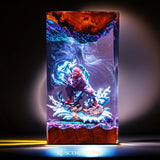
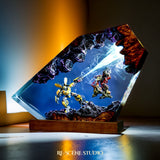
The handcrafted decor category has followed the same pattern. Mass-produced Mando merchandise sells the action-figure version: helmet, blaster, jetpack. Independent makers produce the emotional version: Mando holding Grogu, Mando crouching beside Grogu, the helmet-blessing scene. The pieces fans actually display are the ones that capture the bond, not the gear.
For readers who want to bring the arc into a home office or living room, our complete Star Wars resin lamps guide walks through the catalog piece by piece. For the Father's Day frame specifically, the Mando and Grogu Father's Day case goes through the gift logic in detail, and the Darth Vader Father's Day case covers the original-trilogy generation.
The pattern across all of these is the same. Fans want to display the moments that landed emotionally, not the merchandise that markets cleanly. Star Wars retailers used to fight this trend by pushing toys-as-collectibles. The handcrafted segment of the market has won because it is willing to make the emotional pieces. Independent studios cast the helmet-off scene, the cradle pose, the quiet shared moment. The big retailers are still selling the jetpack.
Frequently Asked Questions
Featured Resin Lamps
Handcrafted with care, each one unique
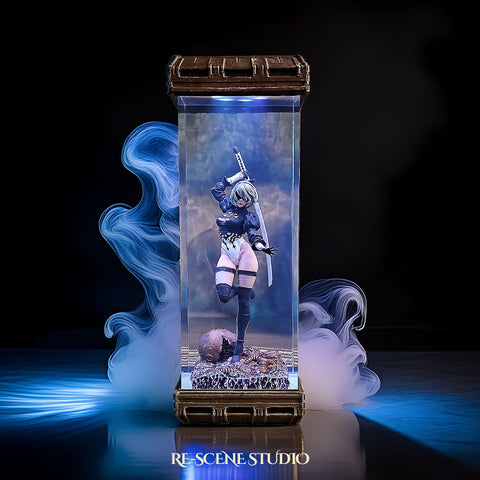
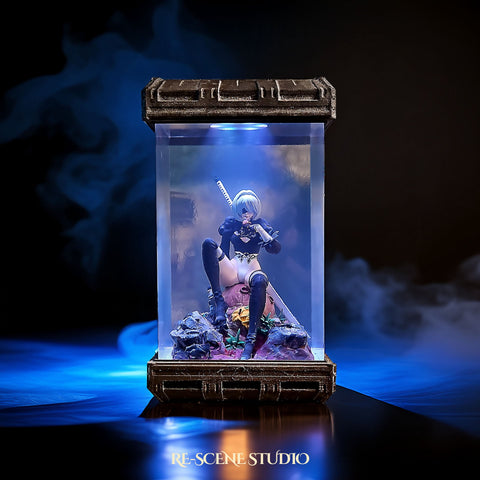
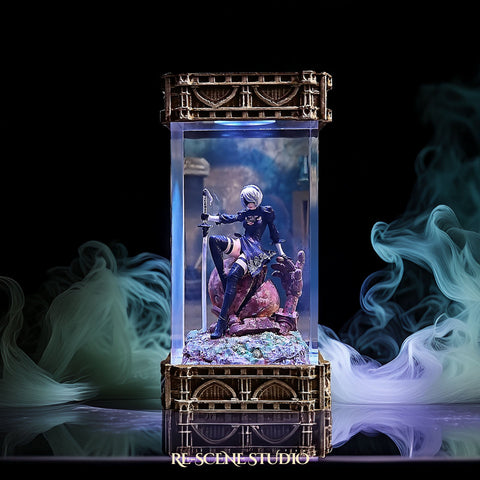
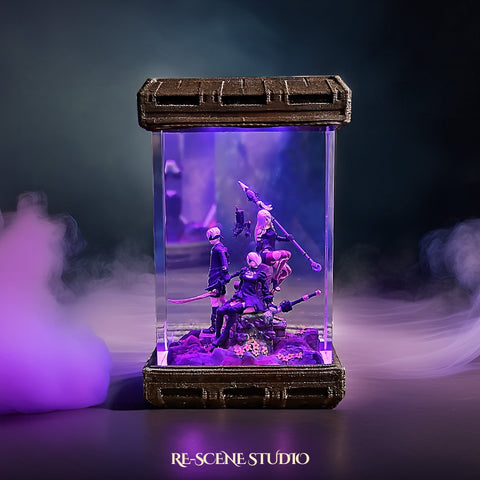
Every lamp we create carries a piece of our heart: a small universe of light, resin, and imagination, handcrafted in our workshop for someone across the world who shares our love for these stories.