






How to Create the Perfect Reading Nook at Home

You have a phone that can stream anything, a laptop on your desk, and a TV in your living room. But somehow, when you actually want to sit down and read, nowhere in your house feels right. The couch is too open. The bed makes you fall asleep in two pages. Your desk chair screams "work mode." If that sounds familiar, you don't need a new house. You need a reading nook.
A reading nook is a dedicated corner designed for one purpose: making you want to stay, read, and forget about your notifications for an hour. And according to Zillow's 2026 Home Trends Report, reading nooks appear in home listings 48% more often than two years ago, reflecting a genuine cultural shift toward screen-free spaces.
The good news? You don't need a renovation, a spare room, or a big budget. Here's how to build one with what you already have.
Step 1: Pick the Right Spot
The best reading nook location has three qualities: it's quiet, slightly enclosed, and away from your main screen areas. You're not looking for a lot of space. A 4x4-foot corner is more than enough.
Great spots most people overlook:
- Under a window: Natural light during the day, curtain-enclosed coziness at night.
- A hallway dead end: Those weird alcoves that feel useless? Perfect nook territory.
- A bedroom corner: Position the nook away from your bed so your brain separates "reading" from "sleeping."
- Under the stairs: If you have a staircase, the space beneath it is naturally cave-like and private.
Avoid spots near the kitchen (food smells and noise), next to the front door (interruptions), or directly facing a TV (your eyes will wander). The slight separation from daily life is what makes a nook feel like a retreat instead of just another chair.

Step 2: Choose Seating That Disappears
In a survey by Houzz, 69% of respondents named the chair as the single most important element of a reading nook. And they're right. If the seat isn't comfortable after 45 minutes, you won't use the nook.
Your three best options, ranked by comfort for long sessions:
| Seating Type | Best For | Budget | Space Needed |
|---|---|---|---|
| Plush armchair with high back | Long reading sessions (2+ hours) | $150-400 | 3x3 ft |
| Window bench with thick cushion | Built-in, space-saving nooks | $80-200 (DIY) | 2x5 ft |
| Floor cushion stack | Small apartments, casual readers | $30-80 | 3x3 ft |
| Hanging egg chair | Statement piece, light reading | $200-500 | 4x4 ft + ceiling mount |
Whatever you choose, add a throw blanket. It sounds trivial, but a blanket signals "relax" to your brain the same way a desk signals "work." It's environmental psychology at its simplest: change the texture, change the behavior.
One detail people miss: the seat height matters. If your feet don't rest flat on the floor (or a footrest), your lower back will ache after 30 minutes. Test this before buying. Sit in the chair at the store for five full minutes, not five seconds. Your reading nook will only be as good as the chair that anchors it.
Step 3: Get the Lighting Right
Lighting is where most reading nooks fail. Too bright feels clinical. Too dim strains your eyes. The sweet spot is layered lighting: one functional light for reading, one ambient light for atmosphere.
For the task light: An adjustable floor lamp or wall-mounted reading lamp positioned over your shoulder. Warm white bulbs between 2700K and 3000K mimic sunset light without the blue-light strain of overhead LEDs. Avoid any lamp that casts a shadow directly onto your page. If you're looking for more lighting guidance, our guide on 5 lighting mistakes that make any room look cheap covers the fundamentals.
For the ambient light: This is where the magic happens. Fairy lights draped along a shelf, a small table lamp on the side, or an accent lamp that emits a soft glow without competing with your reading light. The ambient layer makes your nook feel intentional rather than accidental.
A common mistake is using a single overhead light for reading. Overhead lighting creates harsh shadows on your page and flattens the room's atmosphere. It's the lighting equivalent of eating dinner under fluorescents. The two-layer approach (task + ambient) costs the same but feels dramatically different. You can also use a dimmer switch on your task lamp to adjust brightness based on time of day; brighter in the afternoon, softer in the evening.

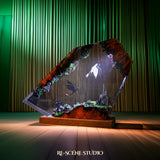
One option worth mentioning for ambient accent lighting: handcrafted resin lamps that use warm LEDs inside sculpted scenes. They emit a soft, diffused glow that works perfectly as a secondary light source. Our Cherry Blossom Resin Lamp, for example, doubles as a decorative piece and ambient light source without overpowering a reading lamp.

Step 4: Add the Details That Matter
Once you have seating and lighting, these finishing touches turn a corner into a nook:
- A small side table or tray: For your tea, coffee, or water. Reaching across the room to set down a drink breaks the spell.
- A rug underneath: Even a small 3x5 rug defines the space visually and adds warmth underfoot.
- One plant: A pothos, snake plant, or small fern adds life without requiring attention. Studies show indoor plants reduce stress by up to 37% (University of Hyogo, 2022).
- A book basket or low shelf within arm's reach: Your "currently reading" stack should be visible. Out of sight = out of mind.
What you should NOT add: a phone charger. The point of the nook is to be phone-free. If your phone is charging right next to you, you'll check it every three minutes. Leave the charger in another room.
Also skip the Bluetooth speaker, at least at first. Reading is one of the last truly quiet activities. The silence itself is part of the reward. If you want background sound, open a window slightly. Real ambient noise beats curated playlists for deep reading focus.

Step 5: Make It Yours (Not Pinterest's)
The biggest mistake people make with reading nooks is designing them for photos instead of use. A Pinterest-perfect nook with white linen, untouched books, and a candle you never light isn't a nook. It's a set.
A real nook has dog-eared pages, a coffee ring on the side table, and a blanket that's permanently crumpled. Design for comfort first, aesthetics second. If it looks "lived in," you're doing it right. For more ideas on making any space feel genuinely comfortable, check out our guide to making any room feel cozy on a budget.
Your reading nook should reflect YOUR taste, not a trend. If you're into anime, add a figure or a themed lamp. If you're into cottagecore, lean into the botanicals. If you're minimalist, keep it stripped back. The nook works when it feels like yours.
One approach that works surprisingly well: build the nook gradually. Start with just a chair and a lamp. Use it for a week. Notice what's missing. Then add one thing at a time. This prevents over-decorating and ensures every item in the nook earns its place. The best reading nooks aren't designed in one shopping trip. They evolve from actual reading habits.
If you share your home, consider making the nook explicitly personal. A small sign, your own blanket, a dedicated bookmark collection. Claiming the space psychologically makes you more likely to use it consistently. It becomes "your" spot, not just "a" spot.
Frequently Asked Questions
Featured Resin Lamps
Handcrafted with care, each one unique




Every lamp we create carries a piece of our heart: a small universe of light, resin, and imagination, handcrafted in our workshop for someone across the world who shares our love for these stories.