



JoJo's Steel Ball Run Explained: A Fresh Start

Most people tell you to start JoJo from Part 1. They're not wrong, but if you want to understand why longtime fans consider Part 7 the series' absolute peak, you don't need 700 chapters of prior context. JoJo Steel Ball Run was designed as a soft reboot, set in an alternate universe where the Joestar name means something entirely different and the familiar rules of Stands no longer apply in quite the same way. You can read it cold and love it. Many fans do.
What you can't do is read it and feel nothing. Steel Ball Run is, by a wide margin, the most emotionally complete arc Hirohiko Araki has ever written. This post breaks down exactly why, from the premise to the power system to the villains, and what we know about the anime adaptation that fans have been waiting years for.
What Is Steel Ball Run?
The setup is almost absurdly simple: it's 1890, and a cross-country horse race has been announced across the United States, starting in San Diego and finishing in Philadelphia. The prize is $50 million, which in 1890 dollars is a life-altering sum. Thousands of riders enter. Most will not finish. The route covers deserts, mountains, rivers, and plains, and there are no rules once the starting gun fires.
That race is the spine of the entire story. Every major event, every confrontation, every revelation unfolds along that route. Araki uses the geography of 1890s America as a storytelling device, so each region the riders pass through carries its own tone and its own dangers. The Midwest arcs feel different from the Rocky Mountain arcs, which feel different from the final East Coast stretch. It reads less like a manga and more like a road novel with Stand battles embedded inside it.
What makes the premise work beyond its surface novelty is what the race represents thematically. It's a story about what people are willing to endure for something they believe in, and whether the thing they believe in is actually worth the cost. That question gets more complicated the further you read.
Why Part 7 Is Considered JoJo's Best
Steel Ball Run consistently tops reader rankings within the JoJo fanbase, and the reasons are worth unpacking rather than just accepting. The first is structural: because it's set in an alternate universe, Araki could break from the escalating power creep that plagued earlier parts. There are no universe-destroying abilities here, no characters who are effectively invincible. Every fight feels like it has real stakes.
The second reason is thematic coherence. Every part of JoJo has a theme, but Steel Ball Run's theme of "what makes someone worthy" threads through every chapter without becoming heavy-handed. The Holy Corpse, the mysterious supernatural MacGuffin at the center of the race, forces every character to reckon with that question in a personal way. Diego wants power. Valentine wants national destiny. Johnny wants something he hasn't been able to name since he was eight years old.
The third reason is the pacing, with one honest caveat: the middle section of the story, roughly the chapters set in the Midwest, slows considerably. Araki introduces several antagonist Stand users in quick succession, and some of those fights feel like filler compared to the emotionally charged sequences before and after them. Fans who pushed through that stretch were rewarded. Readers who expected the opening act's momentum to continue uninterrupted sometimes bounced off. That's a fair criticism of an otherwise exceptional piece of work.

Johnny Joestar: The Most Human JoJo
Johnny is a former horse racing prodigy who was shot in the spine after a petty confrontation, leaving him paralyzed from the waist down. He enters the Steel Ball Run not with any heroic intention but because he saw Gyro Zeppeli's steel balls do something impossible during the opening race, and he wants that power. It's a selfish, desperate motivation, and Araki doesn't clean it up.
What makes Johnny exceptional among JoJo protagonists is that his disability is never treated as something to be overcome narratively. He doesn't learn to walk again as a reward for good character. His wheelchair is part of who he is throughout the story, and his growth as a person happens while that physical reality remains constant. His insecurities, his guilt about his older brother Nicholas, and his fractured relationship with his father Nicholas Joestar Sr. are all threaded through the story with real patience.
His Stand, Tusk, evolves through four Acts, each representing a deeper understanding of the Golden Spin. Tusk Act 1 fires his fingernails as rotating projectiles. Act 2 channels the Spin into a nail that can pivot infinitely inside a wound. Act 3 lets him rotate his entire body to escape otherwise impossible situations. Tusk Act 4 is something else entirely: an attack that rotates at infinite speed, described in the manga as exceeding even the power of the universe's spin. The moment Johnny unlocks Act 4 in the final arc is one of the most celebrated sequences in the series, not because of the power level, but because of what he had to lose to get there.
He's the JoJo who asks out loud whether he deserves to survive. That question feels more honest than most shonen protagonists ever get.
Gyro Zeppeli: The Heart of the Race
Gyro Zeppeli is a royal executioner from a fictional European kingdom called Naples, and he enters the race for a reason he keeps to himself for much of the story: if he wins, his government will pardon a child named Marco who has been sentenced to death under an unjust law. That backstory is revealed slowly, and when it lands it recontextualizes everything about how Gyro presents himself.
Because Gyro presents as loud, irreverent, and fond of terrible puns. "Nyo ho ho" is his signature laugh, and first-time readers often find it grating before they understand it as armor. Gyro was taught from childhood that executioners cannot show emotion, and humor is the closest thing he has to a release valve. The more you understand that, the more painful his funnier moments become.

His fighting style is built around steel balls and the Spin, a technique that generates a rotational force modeled on the Golden Rectangle found in nature. Properly executed, the Spin can heal injuries, deflect projectiles, and amplify force in ways that defy normal physics. Gyro teaches Johnny the fundamentals, and watching that teaching relationship develop is one of the most satisfying mentor arcs in manga. It's not the clean master-student dynamic of, say, Kakashi and Naruto. Gyro is impatient and blunt, and Johnny pushes back. They earn their trust through conflict.
His philosophy, delivered in pieces rather than as a speech, is essentially that the Spin represents a universal truth: things in nature move toward perfect rotation because that's what efficiency looks like. For Gyro, mastering the Spin is about aligning yourself with how the world actually works, rather than forcing the world to bend to your will. Valentine, the main antagonist, represents the opposite philosophy.
The Stand System Reinvented
Steel Ball Run introduces the concept of Stands in a way that doesn't require any prior knowledge of the series. They're called the same thing, but the in-universe explanation is different: Stands here are awakened by proximity to the Holy Corpse, a collection of supernatural body parts scattered along the race route. Acquiring a piece of the Corpse grants a Stand, and collecting more pieces increases that Stand's power. This creates a natural progression system tied directly to the race's geography.
The Act system, exclusive to Tusk, adds another layer. Rather than a Stand simply becoming stronger over time, Tusk evolves into structurally different forms, each with a distinct ability rather than just upgraded stats. This was Araki's answer to the scaling problem that had plagued later parts of the series, where abilities had to become increasingly abstract to feel powerful. Tusk's Acts stay grounded in the mechanics of the Spin, so each evolution feels earned rather than arbitrary.
The Spin itself functions as a parallel power system alongside Stands. Gyro never develops a Stand for most of the story, relying entirely on steel ball technique. This was a deliberate choice: Araki wanted to show that mastery of a physical discipline could compete with supernatural ability. Ball Breaker, the attack Gyro develops in the final arc by channeling the Golden Spin through his steel balls, is one of the most visually inventive fighting techniques in the entire series.

Key Villains: Diego Brando and Funny Valentine
Diego Brando is this universe's version of Dio, and Araki uses the parallel deliberately. Where Dio was a sociopath who cultivated cruelty as a philosophy, Diego is a survivalist whose ruthlessness was shaped by a genuinely brutal childhood. His Stand, Scary Monsters, allows him to transform himself and other living things into dinosaurs, granting him enhanced strength, speed, and regeneration. He is a credible threat for the entire story, and his personal history with poverty and institutional cruelty makes him more sympathetic than he probably should be given the things he does.
Funny Valentine is the main antagonist and arguably the most sophisticated villain Araki has written. He's the 23rd President of the United States, and his Stand, Dirty Deeds Done Dirt Cheap (D4C), allows him to travel between parallel dimensions. Every time he's killed, he simply pulls an alternate-universe version of himself into the prime timeline as a replacement. This makes him effectively unkillable through conventional means and forces Johnny and Gyro to think about the problem differently.
What elevates Valentine above the typical villain role is his ideology. He genuinely believes that collecting the Holy Corpse for America will bring prosperity to his nation, and he frames every terrible thing he does as patriotic duty. The manga doesn't fully endorse or refute this position. It presents Valentine's logic with enough coherence that readers have argued about it for years: is he wrong? Is protecting your own nation at the cost of others defensible? The final confrontation between Johnny and Valentine works precisely because both characters have valid points and neither is entirely right.
Will the Anime Do It Justice?
David Production has handled every JoJo anime adaptation from Phantom Blood through Stone Ocean, and their track record is strong. They've demonstrated genuine affection for the source material, and their fight choreography, particularly in Golden Wind and Stone Ocean, showed they understand how to translate Araki's visual language into animation without losing the rhythm.
The challenge with Steel Ball Run is scale. This is the longest part in the series, spanning 96 chapters across 24 volumes. The race's geography is essential to its atmosphere, and doing it justice will require a visual budget and runtime that exceeds previous parts. Golden Wind had 39 episodes. Steel Ball Run would likely need 52 or more to breathe properly, and that assumes tight pacing throughout.

As of early 2026, David Production has not confirmed Steel Ball Run's production timeline. JoJolion's anime adaptation is the logical next step in the pipeline, and most fans expect Steel Ball Run to follow. The community estimate puts a Steel Ball Run anime announcement somewhere in the 2027-2028 window, with a release no earlier than 2028. That's speculation based on production patterns, not confirmed information.
What we can say confidently: if David Production maintains their current standard, the anime will be worth watching. The source material is exceptional. The question is whether the adaptation will trust that material enough to let the quieter, character-driven scenes land without rushing toward the next fight. The pacing of Gyro teaching Johnny the Spin, or the conversation between Valentine and Scarlet before the final confrontation, those moments need time. They're what separates Steel Ball Run from spectacle and makes it literature.
For fans who can't wait, the manga is easily the best starting point while the 2026 anime season fills the gap, and if you're already building out your anime space, you're not alone in treating franchise decor as part of the experience. Collecting anime as an adult has become its own culture, and Part 7's aesthetic is one of the most distinctive in the medium: the earthy Western tones, the Golden Ratio visual motifs, the way Araki draws horses with that impossible kinetic energy.
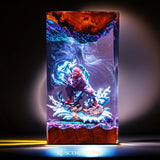
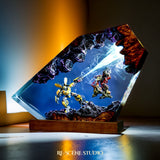
If JoJo's art inspires you to bring that kind of anime energy into your space, pieces like our Gojo Satoru resin lamp capture that same expressive manga aesthetic with handcrafted depth that printed posters can't match.

Frequently Asked Questions
Featured Resin Lamps
Handcrafted with care, each one unique
Every lamp we create carries a piece of our heart: a small universe of light, resin, and imagination, handcrafted in our workshop for someone across the world who shares our love for these stories.