


![[FATHER'S DAY] Ember Glow Ticket | $6.68 — Handcrafted Epoxy Resin LED Lamp | Unique Ambient Decor & Collector's Gift](http://rescenestudio.com/cdn/shop/files/Lucky_Star_Ticket_NYE_2026_c61361fc-ea06-4a31-8379-e16ed7d47902.jpg?v=1767177179&width=320)


Final Fantasy VII: Why Sephiroth Is Gaming's Greatest Villain

Sephiroth is gaming's greatest villain not because he destroys cities or wields an impossibly long sword. He earns that title because he makes you feel his fall. By the time he drives the Masamune into the Planet in Final Fantasy VII, you understand exactly who he was, what broke him, and why he chose this path. That combination of spectacle and psychology has kept players arguing, analyzing, and replaying for nearly thirty years.
No other antagonist in gaming history has matched that combination so completely. This is the definitive breakdown of why Sephiroth Final Fantasy lore continues to resonate, from the Nibelheim incident to the Remake trilogy's multiverse reinterpretation.
The Nibelheim Incident: Where Sephiroth's Story Begins
Most players meet Sephiroth as a looming threat, a presence felt before he is seen. But his story begins years before the events of FF7, in the quiet mountain town of Nibelheim. Cloud and Sephiroth arrive together on a Shinra mission, two soldiers with very different trajectories. Cloud is a failed SOLDIER pretending otherwise. Sephiroth is the most celebrated warrior alive.
What happens in the Shinra Mansion library changes everything. Sephiroth discovers Hojo's research files on the Jenova Project, including documentation suggesting his "mother" Jenova was an Ancient, and that he himself was engineered from her cells. The truth is more complicated, and darker, but Sephiroth does not know that yet. He retreats into the mansion basement for days, reading obsessively, and when he emerges, something fundamental in him has fractured.

The Nibelheim massacre is not random cruelty. It is the logical endpoint of a man who built his entire identity on service and superiority, only to discover both were constructed by the people he served. Sephiroth does not go mad. He makes a decision: if humanity used him as a weapon, he would use humanity as a stepping stone. That coherent motivation is what separates him from every generic "destroy the world" antagonist.
What Makes Sephiroth Different from Other Game Villains
The best gaming villains share at least one quality with the best literary antagonists: you understand their logic even when you reject their actions. Sephiroth has that quality in abundance, but he also does something rarer. He makes the hero's trauma personal.
Cloud's entire arc in Final Fantasy VII is built around memory, identity, and the question of what is real. Sephiroth is not just the antagonist of the plot. He is the antagonist of Cloud's psychology. Every time Cloud thinks he has a grip on who he is, Sephiroth is there to destabilize it. The "Jenova cells" narrative device allows Sephiroth to exist simultaneously as a physical threat and as a mental one, collapsing the boundary between external enemy and internal demon.
| Villain | Motivation | Relationship to Hero | Psychological Depth |
|---|---|---|---|
| Sephiroth (FF7) | Revenge against humanity that weaponized him; desire to become a god | Trauma anchor for Cloud's fractured identity | Very High: backstory recontextualizes every action |
| Ganondorf (Zelda) | Power and domination; cyclical destiny | Cosmic opposite to Link | Medium: Tears of the Kingdom added new layers |
| Kefka (FF6) | Pure nihilism; destruction as art | Ideological foil to Terra | High: genuinely succeeds and rules for a year |
| Baldur's Gate 3's Gortash | Controlled power; pragmatic survival | Political antagonist, limited personal connection | Medium: well-written but not mythic |
Kefka from Final Fantasy VI is a serious rival for this crown. He succeeds where Sephiroth technically fails, actually destroying the world and ruling its ruins for a year. But Kefka's nihilism, while brilliantly executed, is one-note by design. Sephiroth carries contradictions: the pride of a decorated general and the grief of someone whose entire self was a lie. That internal conflict makes him more interesting to analyze, even if Kefka is arguably more terrifying in the moment.
Sephiroth Across the Final Fantasy VII Timeline
One of the most underrated aspects of FF7 Sephiroth lore is how the character functions differently across the game's extended timeline. In the original game, he is largely absent in body but omnipresent in memory and threat. In Crisis Core: Final Fantasy VII, players see him before Nibelheim, and the effect is devastating. He is charming, principled, and genuinely worth admiring. The tragedy of the original game hits harder when you have seen the before.
Crisis Core: Final Fantasy VII Reunion (2022) made this prequel story accessible to a new generation with remastered visuals and a fully voice-acted script. The relationship between Zack and Sephiroth in that game is one of the most effective pieces of character work in the franchise, because it shows Sephiroth as someone capable of real friendship before the break. Watching that person become the monster is the entire point.

Final Fantasy VII: Advent Children (2005) handled his return in a way that could have felt like fan service but worked because it deepened the metaphor. Sephiroth's resurrection through Kadaj and the Remnants literalized the psychological truth of the original game: trauma does not stay dead. Cloud's ongoing illness (Geostigma) is the planet's wound and his own wound, and Sephiroth is the infection. When he finally says "I will never be a memory," it lands as both dramatic confrontation and honest psychology.
The Remake Trilogy: Sephiroth Reimagined
Final Fantasy VII Remake (2020) made a choice that split the fanbase and energized critical discussion: Sephiroth appears too early and seems to be aware of the original game's timeline. The Whispers, fate-enforcing entities that react to deviations from the "known" story, suggest something larger is being set up. Many players initially read this as Square Enix hedging its bets on the narrative. With Final Fantasy VII Rebirth (2024), the vision became clearer.
The Remake trilogy is not simply retelling FF7. It is running a parallel track where Sephiroth is not just a villain inside the story but a kind of narrative agent actively trying to prevent a different outcome. The meta-awareness raises fascinating questions about free will, destiny, and whether the "canon" ending is actually the best outcome or merely the familiar one. For fans who have played the original, this adds a layer of genuine unease that straightforward nostalgia could never achieve.

What the Remake trilogy does brilliantly is make the question of Sephiroth's nature genuinely uncertain. Is he a product of Jenova's will, an expression of Cloud's trauma, a being who achieved something like godhood through the Lifestream, or all three simultaneously? The ambiguity is not a writing failure. It is the game trusting players to sit with complexity, which is exactly the quality that elevated the original in 1997.
Sephiroth's Legacy in Gaming Culture
The cultural footprint of FF7 Sephiroth extends well past the franchise itself. He is the villain other game directors cite when discussing what a truly memorable antagonist requires. He popularized the "fallen hero turned villain" archetype in JRPGs, a template followed by antagonists from Gwyn in Dark Souls to Kratos's early self in God of War. If you have ever felt genuine sympathy for a game's villain, Sephiroth helped build that expectation.
His visual design remains one of the most recognizable in gaming. The silver hair, the Masamune, the single black wing: each element was deliberate. Designer Tetsuya Nomura wanted a figure who looked otherworldly but not monstrous, someone whose beauty and menace coexisted without resolving into either. That ambiguity is part of why fan communities continue producing art, analysis, and cosplay decades after the original release.
The Super Smash Bros. Ultimate reveal in 2020 confirmed what the broader gaming community had long acknowledged: Sephiroth is not just a Final Fantasy icon but a gaming icon without qualifier. His moveset, faithfully adapted from FF7 mechanics, became one of the most discussed DLC additions in the game's history. If you want a deeper dive into how game antagonists build this kind of lasting presence, our breakdown of why Kratos still captivates gamers covers the other great example of a character whose complexity outlasts the initial game cycle.
For players who prefer lore delivered through environment and silence, the Dark Souls lore guide for beginners shows how FromSoftware built their own tragic antagonists using an entirely different narrative approach. Both methods produce villains worth studying.
Final Fantasy VII Resin Lamps: The One-Winged Angel on Your Desk
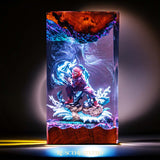
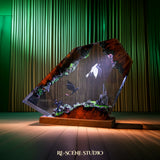
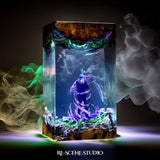
Sephiroth's design translates to physical art better than almost any game character. The contrast of silver light against dark resin, the dramatic silhouette, the sense that something powerful is contained inside the piece: it maps directly onto what skilled artisans do with resin and LED light. Our Sephiroth lamps are handcrafted to order, and no two come out identical.

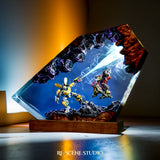
The Sephiroth vs. Cloud lamp captures the definitive confrontation of the franchise: two figures who were shaped by the same experiments, the same grief, and the same war, arriving at completely opposite conclusions about what life is worth. As a display piece, it works for any desk or shelf. As a statement about one of gaming's greatest rivalries, it says everything without needing a caption.

Both are handcrafted to order by our artisan workshop. Because each lamp is made individually, the resin patterns shift slightly with every pour, making your piece genuinely one of a kind. If you plan to give one as a gift, we recommend ordering well in advance. Check the product page for current delivery estimates.
Frequently Asked Questions
Featured Resin Lamps
Handcrafted with care — each one unique


Every lamp we create carries a piece of our heart — a small universe of light, resin, and imagination, handcrafted in our workshop for someone across the world who shares our love for these stories.