






![[FATHER'S DAY] Ember Glow Ticket | $6.68 — Handcrafted Epoxy Resin LED Lamp | Unique Ambient Decor & Collector's Gift](http://rescenestudio.com/cdn/shop/files/Lucky_Star_Ticket_NYE_2026_c61361fc-ea06-4a31-8379-e16ed7d47902.jpg?v=1767177179&width=320)


Why No Two Resin Lamps Are Identical: The Science of Handcraft

Pick up two handmade resin lamps from the same product line and hold them side by side. You will notice something immediately: they are not the same. The colors blend slightly differently. The layers settle at subtly different depths.
The light passes through the resin at unique angles, creating glow patterns that belong to that single piece and no other. This is not a defect. This is the entire point. Every handmade resin lamp is unique because the craft itself makes exact duplication impossible.
In a world dominated by injection-molded plastic and assembly-line consistency, handcrafted resin art stands apart. The same properties that make resin such a beautiful medium also make it inherently unpredictable. Temperature, humidity, pour speed, pigment concentration, and curing time all interact in ways that produce one-of-a-kind results. Understanding why no two resin lamps are identical means understanding the science behind the craft.
How Resin Actually Works: The Chemistry of Curing
Epoxy resin is a two-part system. Part A is the resin itself, and Part B is the hardener.
When mixed together, they trigger an exothermic chemical reaction called polymerization. The liquid molecules cross-link into a rigid, transparent solid. This process takes hours to complete and generates heat as it progresses.
Here is where uniqueness begins. The rate of polymerization depends on the ambient temperature in the workshop.
A few degrees warmer and the resin cures faster, which affects how pigments settle and how air bubbles migrate through the material. A few degrees cooler and the curing slows, allowing colors to drift and blend more extensively before the resin solidifies. Even in a controlled workshop environment, these variables shift from pour to pour.
Humidity plays a role too. Moisture in the air can create micro-reactions on the resin surface during the curing window. This sometimes produces a subtle clouding effect that experienced artisans learn to use creatively rather than fight against. The atmospheric conditions on the day of the pour become part of the piece's character.
The exothermic reaction itself adds another layer of variability. As resin cures, it generates heat from the center outward.
Thicker pours generate more heat, which accelerates curing in the core while the outer layers are still fluid. This temperature gradient causes pigments and inclusions to behave differently at different depths within the same piece. The result is a three-dimensional color effect that no two pours can replicate exactly.
The Art of Layered Pours
Most resin lamps are not made in a single pour. They are built up in multiple layers, each one mixed, pigmented, and poured separately. A single lamp might require three to six individual pours over the course of several days. Each layer must partially cure before the next is added, and the timing of each subsequent pour affects how the layers bond and interact.
Color blending between layers is one of the most striking sources of variation. When a new layer of pigmented resin is poured over a partially cured layer beneath it, the boundary between them is not a clean line. Pigments from the fresh pour migrate slightly into the tacky surface below, creating a gradient zone that is impossible to control with precision. The width, color intensity, and pattern of this gradient are different every time.

Inclusions, the small decorative elements embedded within the resin, add further uniqueness. Miniature figures, dried flowers, metallic flakes, and LED components are all placed by hand. Even when an artisan follows the same design reference, the exact position, angle, and depth of each inclusion varies.
A figure placed one millimeter to the left catches light differently. A metallic flake that rotates during the pour reflects at a new angle. These micro-variations accumulate into visible differences between finished pieces.
The LED lighting system interacts with all of these variables. Light traveling through resin bends and scatters based on the material's density, any internal boundaries between layers, and the position of pigments and inclusions. Because no two pieces have identical internal structures, no two pieces glow the same way when illuminated. The light itself becomes a fingerprint of that specific lamp's construction.
Why Mass Production Cannot Replicate This
Factory-made products achieve consistency through standardization. Injection molding uses precise molds, controlled material temperatures, and automated processes to produce thousands of identical units. This is excellent for products where uniformity is the goal. But it is fundamentally incompatible with the properties that make resin art compelling.
Resin requires open-air curing, manual pigment mixing, and hand-placed components. These are not limitations that better machinery can overcome.
They are intrinsic to the medium. A machine can mix resin to exact ratios, but it cannot control how pigments disperse once they hit a partially cured layer. A robot arm can place an inclusion at precise coordinates, but it cannot predict how the surrounding resin will flow around it during curing.
This is why every handmade resin lamp is unique in a literal, physical sense. The variations are not a marketing story layered on top of an otherwise uniform product. They are built into the chemistry and physics of the material. When you buy a handcrafted resin lamp, you are buying a piece that exists once and will never be duplicated, because the conditions that created it will never align in exactly the same way again.

The Human Element: Artisan Skill and Intuition
Behind every resin lamp is an artisan who has spent years developing an intuition for the material. Experienced resin workers can read the viscosity of a mix, judge the cure state of a layer by touch, and adjust their technique based on workshop conditions that day. This is not something that can be fully documented in a manual. It is embodied knowledge, the kind that lives in muscle memory and trained observation.
Our artisan workshop employs craftspeople who specialize in different aspects of the process. Some focus on the structural pour, building up the base layers that give the lamp its form and strength. Others specialize in detail work, placing miniature figures and fine inclusions with tweezers and needle tools. The final finish, sanding, polishing, and quality inspection, is another specialized skill set entirely.
Each artisan brings their own subtle style to the work. One might pour with a slightly more aggressive motion that creates dynamic swirl patterns. Another might favor a slow, steady pour that produces calmer, more uniform color fields. These personal touches are invisible to someone who has never studied the craft, but they contribute to the distinctive character of each finished piece.

What This Means for Collectors
For collectors, the uniqueness of handmade resin lamps adds a dimension that mass-produced items cannot offer. When you purchase a handcrafted piece, you are not selecting from identical stock. You are acquiring a singular object. The specific way light moves through your lamp, the exact color gradients in its layers, the precise positioning of every inclusion: these belong to your piece alone.
This also means that product photos, while representative of the design, will never be a pixel-perfect match to the piece you receive. Colors may be slightly warmer or cooler. Layer boundaries may sit at different heights.
The glow pattern when lit may emphasize different areas. Experienced collectors understand this and appreciate it. The slight surprise of seeing how your specific piece turned out is part of the joy of collecting handcrafted art.
Some collectors specifically seek out pieces with more dramatic natural variations, valuing the bold color sweeps or unexpected pigment blooms that result from the resin's organic behavior. Others prefer subtler, more controlled results. Both are valid approaches, and both are possible within the handcraft process. The artisan guides the resin, but the material always has the final say.

Caring for Your One-of-a-Kind Piece
Because each resin lamp is unique, caring for it properly ensures its beauty lasts for years. Keep the lamp away from direct sunlight for extended periods, as UV exposure can cause gradual yellowing in some resin formulations. A spot with indirect natural light or purely artificial lighting is ideal for display.
Clean the surface with a soft, dry microfiber cloth. Avoid chemical cleaners, ammonia-based sprays, or abrasive materials, as these can dull the polished finish. For stubborn fingerprints, a slightly damp cloth followed by a dry buff is sufficient. The resin surface is durable but responds best to gentle care.
The LED components inside the lamp are designed for long-term use, but like all electronics, they perform best when not left running continuously for days at a time. Most owners use their lamps as ambient lighting for several hours in the evening, which is the ideal usage pattern for both the LED lifespan and the visual impact of the piece. The warm glow against a dim room is where handcrafted resin lamps truly shine.
Frequently Asked Questions
Featured Resin Lamps
Handcrafted with care — each one unique


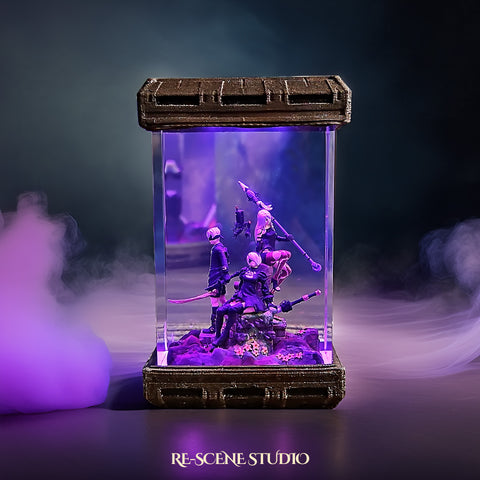
Every lamp we create carries a piece of our heart — a small universe of light, resin, and imagination, handcrafted in our workshop for someone across the world who shares our love for these stories.