




![[FATHER'S DAY] Ember Glow Ticket | $6.68 — Handcrafted Epoxy Resin LED Lamp | Unique Ambient Decor & Collector's Gift](http://rescenestudio.com/cdn/shop/files/Lucky_Star_Ticket_NYE_2026_c61361fc-ea06-4a31-8379-e16ed7d47902.jpg?v=1767177179&width=320)


What Makes a Good Night Light? Science Behind Better Sleep

A good night light helps you sleep. A bad one keeps you awake without you realizing it. The difference comes down to color temperature, brightness, and wavelength. Most people choose night lights based on how they look on a shelf, ignoring the science that determines whether that light supports or sabotages their sleep cycle. This guide covers what actually matters.
If you have ever wondered why you sleep worse with a blue-tinted LED strip running or why your phone's night mode exists, the answer is melatonin. Your brain produces this hormone in response to darkness. Certain light wavelengths suppress melatonin production, delaying sleep onset by 30 minutes or more. The best night light for sleep is one that works with your biology, not against it.
How Light Affects Your Sleep: The Melatonin Connection
Melatonin production begins when your brain detects reduced light levels, typically about 2 hours before your natural bedtime. This process is controlled by photoreceptors in your eyes called intrinsically photosensitive retinal ganglion cells (ipRGCs). These cells are most sensitive to blue light wavelengths between 460 and 480 nanometers.
When blue light hits these cells, they send a signal to your brain's suprachiasmatic nucleus (the master clock) that says "it is still daytime." Your brain responds by suppressing melatonin production. The result: you feel alert when you should be winding down, you take longer to fall asleep, and the sleep you do get is lower quality because your circadian rhythm was disrupted.

This is not theoretical. A 2019 study published in Current Biology found that even moderate blue light exposure in the evening reduced melatonin production by 50% compared to dim amber light. Participants exposed to blue light before bed took an average of 30 minutes longer to fall asleep and reported feeling less rested the following morning. Over time, chronic melatonin disruption has been linked to increased rates of insomnia, mood disorders, and metabolic issues. The takeaway is clear: the color of your bedside light matters as much as its brightness, and possibly more than the mattress you sleep on.
The Best Night Light Colors for Sleep (Ranked)
Not all colors affect sleep equally. Here is how they rank from most sleep-friendly to most disruptive, based on wavelength and melatonin impact.
| Light Color | Wavelength | Color Temp | Melatonin Impact | Sleep Rating |
|---|---|---|---|---|
| Red/deep amber | 630+ nm | 1800-2200K | Minimal suppression | Best |
| Warm amber | 590-630 nm | 2200-2700K | Low suppression | Very good |
| Warm white | 570-590 nm | 2700-3000K | Moderate suppression | Acceptable |
| Neutral white | 500-570 nm | 3500-4000K | Significant suppression | Poor |
| Cool white/blue | 460-500 nm | 5000-6500K | Maximum suppression | Worst |
The sweet spot for a bedroom night light is between 1800K and 2700K. Anything labeled "warm white" or "soft glow" at 2700K or below is a safe choice. Red and deep amber lights at 1800K to 2200K are ideal if your primary goal is sleep quality rather than ambient aesthetics.
Brightness Matters as Much as Color
Even sleep-friendly wavelengths can disrupt rest if the brightness is too high. A dim amber light at 5 lumens supports sleep. That same amber light at 200 lumens will keep you more alert than necessary. For a night light used while sleeping, aim for 1 to 10 lumens. For a bedside lamp used during a pre-sleep wind-down routine, 20 to 50 lumens is the comfortable range.
For context, a standard 60-watt equivalent LED bulb produces about 800 lumens. A candle produces about 12 lumens. The best night lights for sleep sit closer to the candle end of that spectrum. Bright enough to navigate a dark room safely, dim enough to not register as "daytime" to your brain.
If you are using a smart bulb, set an automation to dim to 10% brightness and shift to warm tones (2200K) about an hour before your target bedtime. This gradual transition mimics sunset and gives your brain time to ramp up melatonin production naturally.
The Pre-Sleep Lighting Routine That Actually Works
Sleep researchers recommend a three-phase approach to evening lighting. Phase one starts about 2 hours before bed: switch your main room lights to warm white (2700K) and reduce brightness to 50%. Phase two starts 1 hour before bed: turn off overhead lights entirely and rely on a single warm lamp or accent light. Phase three is bedtime: either complete darkness or a very dim amber source under 5 lumens.
This sequence works because it gives your circadian system clear, progressive signals that day is ending. Most people skip straight from full room lighting to total darkness and then wonder why they lie awake for 30 minutes. The transition period is where melatonin production happens. Skip it, and your brain is still in daytime mode when your head hits the pillow.
Consistency matters more than perfection. Running this routine at roughly the same time each evening trains your circadian clock to expect sleep at a predictable hour. Even on weekends, try to stay within 30 minutes of your weeknight schedule. Irregular light exposure is one of the top contributors to chronic insomnia, according to the American Academy of Sleep Medicine.
What to Avoid in a Bedroom Light
Certain popular night light types actively harm sleep quality despite being marketed as "sleep aids."
LED strips with blue or RGB modes are the biggest offenders. The default blue setting on most LED strip kits emits peak wavelengths right in the 460nm zone that maximally suppresses melatonin. Even the "warm" settings on cheap RGB strips often have blue light leakage that is invisible to the eye but detectable by your ipRGC cells.
Salt lamps are popular but wildly variable. A high-quality Himalayan salt lamp with a low-wattage bulb produces a warm amber glow that is genuinely sleep-friendly. But many modern salt lamps use LED replacements that skew cooler than the traditional incandescent bulbs they were designed for. Check the actual color temperature, not just the marketing claims.
Phone screens, even with night mode enabled, are still too bright and too blue for pre-sleep use. Night mode reduces blue light by 20 to 40%, but the remaining 60 to 80% at high brightness still suppresses melatonin significantly. If you must use your phone before bed, combine the filter with minimum brightness and hold the screen at arm's length rather than close to your face. Better yet, switch to an e-reader with a warm backlight or read a physical book by lamplight.
Overhead ceiling lights are another overlooked problem. Even warm-toned overhead fixtures create top-down illumination that your brain interprets as midday sun. For the last hour before bed, use only table-level or floor-level light sources. The lower angle mimics sunset conditions and signals your circadian system more effectively than the same color temperature from directly above.

Resin Lamps as Night Lights: Do They Work?
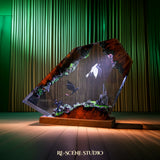
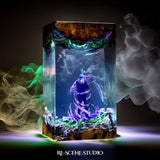
Handcrafted resin lamps use low-wattage LED modules (typically under 2 watts) that emit warm white light through tinted epoxy resin. The resin acts as a natural diffuser, softening the light and filtering out harsher wavelengths. The result is a warm, ambient glow that sits comfortably in the sleep-friendly 2200K to 2700K range.
Unlike traditional lamps with exposed bulbs or direct LED elements, resin diffuses the light across the entire body of the piece. There is no single bright point source, just an even glow emanating from within the scene. This diffused quality makes resin lamps particularly comfortable for bedside use because your eyes never encounter a concentrated spot of brightness. The visual experience is closer to candlelight than to a standard lamp, which is exactly what your circadian system prefers in the evening hours. It is also safer than an actual candle, with no flame, no heat buildup, and no fire risk.
The USB power draw is negligible. Running a resin lamp overnight for an entire year costs less than $2 in electricity. Compare that to a 40-watt table lamp at roughly $15 per year, and the efficiency case is clear alongside the sleep benefit.
The Deep Blue Ocean Resin Lamp uses blue-tinted resin, but the LED itself emits warm white light. The blue is in the resin, not the light source, so it does not carry the same melatonin-suppressing wavelength as a blue LED. The warm light passing through blue resin creates a calming visual effect without the biological downsides of actual blue light emission.

For bedrooms specifically, nature-themed designs like the Eternal Rose Garden Lamp ($89) work well. The warm amber resin and soft LED produce the kind of diffused glow that complements a pre-sleep wind-down without the intensity of a traditional table lamp. Many customers report leaving these on as overnight night lights with no sleep disruption.

For deeper reading on how lighting layers work across a full room, check our psychology of ambient lighting guide and the warm white vs cool white LED guide.
Frequently Asked Questions
Featured Resin Lamps
Handcrafted with care — each one unique



Every lamp we create carries a piece of our heart — a small universe of light, resin, and imagination, handcrafted in our workshop for someone across the world who shares our love for these stories.