





Night Lights for Adults: How to Choose the Right One

You wake up at 3 AM, need to use the bathroom, and you have two choices: stumble through complete darkness and stub your toe on the same corner of the bed frame for the hundredth time, or flip on the overhead light and spend the next forty minutes staring at the ceiling while your brain decides it's morning now. Neither option is great. A night light would solve both problems instantly, and yet somehow the idea still feels vaguely childish. So you skip it. And you keep stubbing your toe.
Here's the thing: night lights are not just for nurseries anymore. The adult night light market has grown into a genuine design category, with options ranging from smart bulbs that sync with your sleep schedule to sculptural ambient pieces that double as room decor. The challenge isn't finding a night light. It's finding one that doesn't look out of place in a grown-up bedroom, hallway, or home office. This guide breaks down exactly what to look for, which types work best in different situations, and what to skip entirely.
Why Adults Actually Need Night Lights (The Science Is Clear)
The case for adult night lights starts with fall prevention. The National Council on Aging estimates that falls are the leading cause of injury among adults over 65, and a significant percentage happen at night when navigating an unlit space. But you don't have to be in your sixties to benefit. Anyone getting up in the night to use the bathroom, check on a noise, or grab a glass of water is doing so in a state of partial wakefulness where depth perception and reaction time are genuinely reduced. A low-level light source between your bedroom and bathroom is a basic safety measure, not a comfort crutch.
The sleep science angle is equally compelling. The problem most people have with turning on lights at night isn't the light itself; it's the wrong kind of light. Bright overhead lighting floods your eyes with blue-spectrum wavelengths that suppress melatonin, your body's natural sleep signal. A well-chosen night light uses warm amber or red tones at low intensity, enough to navigate safely without telling your brain it's time to start the day. Sleep researchers at Harvard Medical School have consistently shown that avoiding blue light exposure in the two hours before bed improves sleep onset time and overall sleep quality. A dim, warm night light is not just acceptable from a sleep hygiene standpoint. It's actively better than stumbling around in the dark and shocking yourself awake when you inevitably bang into something.
There's also the anxiety angle. A 2022 survey by the American Sleep Association found that 50 to 70 million American adults have ongoing sleep issues, with nighttime anxiety being one of the top reported contributors. For people who experience heightened anxiety at night, a small consistent light source in the room reduces the psychological stress of total darkness without disrupting sleep. Interior designers and sleep therapists often recommend warm ambient lighting as part of a wind-down environment for exactly this reason. You can read more about the relationship between light and emotional state in our post on the psychology of ambient lighting and why some rooms feel calm.

What to Look for in an Adult Night Light
Shopping for a tasteful adult night light comes down to five criteria. Get all five right and you'll have something that works well and looks intentional in your space. Skip one and you might end up with something you hide in a drawer after a week.
Brightness Level
The sweet spot for a bedroom night light is between 1 and 10 lumens. That's dim enough to preserve your dark adaptation while being bright enough to navigate a hallway without using your hands to feel along the wall. For reference, a standard 60-watt bulb emits around 800 lumens. Most quality adult night lights are dimmable or have preset modes. Anything that tops out above 20 lumens in a bedroom context is going to feel intrusive once your eyes have adjusted to the dark. For hallways and bathrooms, you can go a little brighter, somewhere in the 20 to 50 lumen range, since those spaces need functional visibility rather than ambiance.
Color Temperature
Color temperature is measured in Kelvin (K). Lower numbers are warmer (more red and amber), higher numbers are cooler (more white and blue). For night use, you want 1800K to 2700K maximum. Anything above 3000K starts introducing blue-spectrum light that works against your sleep. Red-spectrum light (under 1800K) is the most sleep-friendly option available. Amber falls in the middle and works well for most people. Avoid any night light described as "cool white," "daylight," or "5000K+." Those are designed for task lighting, not sleep environments.
Design and Aesthetic
This is where most people go wrong. They pick a night light based purely on function and end up with something that looks like it came with a pack of three from a discount bin. A night light in your bedroom is visible every time you look at your nightstand, which is dozens of times a day. It should look like something you chose intentionally. The bar for design in the adult night light space has risen dramatically. You can now find options that look like small sculptures, textured glass objects, botanical art pieces, or architectural accent lights. The function is secondary to how well it integrates with your existing space.
Auto-Off and Sensor Features
The most convenient adult night lights either have a built-in light sensor (turns on automatically when the room gets dark, off at dawn) or a motion sensor (activates only when you're moving through the space). Both options eliminate the need to remember to turn anything on or off. Timer functions are also useful if you want the light on for a set window, say 11 PM to 6 AM, without manual intervention. Avoid anything that requires you to physically switch it on and off every night; that friction is enough to make most people stop using it after a week.
Power Source
Plug-in night lights are reliable and never need charging. They work best in rooms where you have an outlet in a useful position. USB-powered options offer flexibility if you have a charging hub on your nightstand. Battery-powered lights give you placement freedom anywhere in the room but require occasional battery changes. Rechargeable options (often USB-C) are the best of both worlds for bedside or standalone use: no cord management issues, no dead batteries at an inconvenient moment.
Best Types of Night Lights for Adults
The adult night light market breaks into four practical categories. Each has a distinct use case and set of trade-offs.
Plug-In Motion Sensor Lights
These are the most practical choice for hallways, bathrooms, and staircases. They sit in a standard wall outlet, activate when they detect movement, and turn off automatically after a set delay. Brands like Maxxima and GE make reliable options in the $10 to $20 range. They're intentionally minimal in design because they're functional tools, not decor. Look for ones with adjustable sensitivity and a warm-white setting (2700K or below) rather than a cool-white default. These are the set-it-and-forget-it solution for anyone whose primary concern is safety in the dark.
Smart Ambient Lights
Smart lights like the Philips Hue Go or the Casper Glow Light take the concept further by connecting to your phone or smart home system. You can schedule them to dim gradually as your bedtime approaches, shift color temperature from warm amber to deep red as the night progresses, and trigger automatically based on sunset. The Casper Glow Light in particular was designed with sleep in mind: twist it to dim, flip it upside down to turn it off. It's a $89 device that genuinely changes nighttime behavior for people who are serious about sleep quality. The Hatch Restore 2 goes even further by combining a sleep sound machine, sunrise alarm, and ambient light in one unit, worth considering if you're building out a full sleep environment rather than just adding a night light.
Ambient Art Pieces and Sculptural Lights
This is the category where design and function genuinely merge. Instead of hiding your night light in an outlet near the floor, you put it on a surface where it belongs as part of the room. IKEA's SYMFONISK line and similar table-top LED pieces give you soft ambient glow in forms that read as intentional decor rather than functional add-ons. At the higher end of this category are handcrafted resin lamps that cast diffused, warm light through sculpted material. Because each piece is made by hand, the light that passes through is slightly different from every angle, giving you a light source that also functions as a sculptural object.
The Wishing Dandelion Globe Resin Lamp is a good example of this type. It's a globe form with dandelion seed heads suspended inside the resin, casting soft organic shadows across a nightstand or shelf. The warm LED inside runs at low intensity, making it appropriate for overnight use without being disruptive. It's the kind of thing that looks like you have a taste, rather than a backup light source from a hardware store.

Color-Changing and Mood Lights
Color-changing options like the Govee Ambient Light Bar or small RGB desk lamps give you control over both color and intensity, useful if your nighttime light needs shift between winding down (deep red, minimal intensity) and reading in bed (warm white, slightly brighter). These work best in conjunction with a smart home setup or a simple remote. The risk with color-changing lights is choosing the wrong color by default. If the light defaults to cool white or bright blue when it powers on, that defeats the purpose entirely. Check that any color-changing light you buy saves your last setting and wakes up to your preferred mode, not a factory default.
Night Light Color Temperature Guide

Understanding color temperature takes about two minutes and saves you from buying something that looks right but makes sleeping harder. The Kelvin scale runs from around 1000K (candle flame, very warm red) up to 6500K+ (overcast sky, harsh blue-white). For nighttime use, the goal is to stay as low on that scale as possible while still having enough light to function.
| Color Temp | Appearance | Sleep Impact | Best Use |
|---|---|---|---|
| 1800K or below | Deep amber / red | Minimal melatonin disruption | Bedroom overnight, anxiety reduction |
| 2200K to 2700K | Warm white / candlelight | Low disruption, most people tolerate well | Bedroom nightstand, hallway |
| 3000K to 3500K | Soft white | Moderate disruption after extended exposure | Bathroom if you need task visibility |
| 4000K to 5000K | Neutral to cool white | Significant melatonin suppression | Not recommended for nighttime use |
| 5000K and above | Daylight / blue-white | Strongly suppresses melatonin | Avoid after sunset entirely |
Red light deserves a separate note. It sits at the lowest end of the visible spectrum and has the least impact on melatonin of any visible light color. Astronomers use red lights at observatories because red doesn't destroy night vision the way white or blue light does. For people with serious sleep sensitivity or anxiety-related insomnia, a deep red night light (around 1800K or a dedicated red LED) is the gold standard. The tradeoff is that everything looks slightly monochromatic and unsettling under pure red light. Most people find warm amber (2200K to 2500K) a good balance between sleep-friendliness and visual comfort.
If you're already paying attention to lighting choices in your space, you might also find useful context in our post about 5 lighting mistakes that make any room look cheap, which covers color temperature as part of the broader picture.
Products to Skip
As important as knowing what to buy is knowing what to avoid. Several categories of night lights are genuinely bad fits for adult spaces, either because of how they look or how they perform.
Plastic Character Shapes
The molded plastic night lights shaped like cartoon animals, stars, moons, or characters from children's media have no place in an adult bedroom unless you're putting one in a child's room. They're made from cheap materials that yellow and discolor over time, the light quality is usually poor (high color temperature, uneven diffusion), and they telegraph "this was not chosen intentionally." Skip entirely.
Ultra-Bright "Night Lights" That Are Just Small Lamps
Some products marketed as night lights are simply low-wattage desk lamps or decorative LED pieces with no dimming capability and output in the 100 to 300 lumen range. That's not a night light. That's a lamp. At full output it will light up a small bedroom noticeably, disrupt your partner if you have one, and suppress melatonin just as effectively as your overhead light would. If you're buying something for nighttime use, check the lumen output before purchasing. Any product that doesn't list its lumen output is a red flag.
Flickering "Flame" LED Lights Without Dimming
The flickering LED flame lights have become popular as ambient decor, and at appropriate brightness levels they're genuinely pleasant. The cheap versions, however, flicker at irregular rates and run at output levels that are too bright for a sleep environment. The flickering effect is also produced by rapid LED switching that some people find subtly stimulating rather than calming. If you want that warm candle-like aesthetic, choose a product from a brand that lists its flicker frequency and lumen output clearly. The Govee and Philips lines both offer flame simulation at controllable brightness. The $8 no-brand versions from discount sites are not worth the gamble.
Cool-White Plug-In Utility Lights
The flat white oval plug-in lights found in multi-packs at hardware stores serve a function in basements and utility spaces. In a bedroom they're the lighting equivalent of a paper towel holder on a dining table: technically functional, completely wrong for the context. Their default color temperature is usually 4000K to 6000K. Even at low output, that color range signals wakefulness to your brain. If budget is the primary concern and you want a simple plug-in option, look for ones that specifically state "warm white" or "amber" and confirm the Kelvin value is 2700K or below.
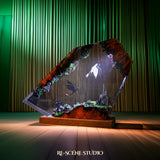
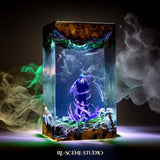
The second of the two pieces we'd highlight from Rescene Studio fits into the sculptural ambient category rather than a utility solution. The Moonlight Forest Resin Epoxy Lamp uses layered resin to create a depth effect, with silhouetted trees and a soft internal glow that reads more as a piece you'd put on a bookshelf or nightstand than as a practical lighting tool. The warm LED inside puts out enough light to serve as ambient glow in a dark room without being intrusive. It's the kind of piece where someone notices it and asks where you got it rather than asking why you have a night light in your room.

Quick Buying Checklist
- Brightness: 1 to 10 lumens for bedrooms; 20 to 50 lumens for hallways
- Color temperature: 2700K maximum; 1800K to 2200K is ideal
- Auto features: Light sensor, motion sensor, or timer so you don't have to think about it
- Design: Something you'd leave visible on a surface, not hide behind a piece of furniture
- Power: Plug-in for reliability; rechargeable for placement flexibility
- Avoid: Cool-white output, no-brand flickering lights, plastic character shapes
Frequently Asked Questions
Featured Resin Lamps
Handcrafted with care, each one unique



Every lamp we create carries a piece of our heart: a small universe of light, resin, and imagination, handcrafted in our workshop for someone across the world who shares our love for these stories.