






How to Light a Small Room Without Overhead Fixtures

If your apartment or rental has no overhead light fixture, you already know the frustration. You flip the switch by the door and nothing happens. The room stays dark, and you're left fumbling for a lamp cord somewhere across the room. About 30% of older apartments in the US lack ceiling fixtures in bedrooms and living rooms, so this problem is far more common than it should be.
The good news: rooms without overhead lighting actually have better design potential than rooms with harsh ceiling fixtures. You just need to think in layers instead of relying on a single light source. Here's exactly how to do it, with specific product suggestions at every price point.
The Three-Layer Lighting Strategy
Professional interior designers use a framework called layered lighting. Instead of one bright overhead source, you combine three types of light at different heights and intensities. The result is a room that feels warm, dimensional, and inviting rather than flat and clinical.
| Layer | Purpose | Examples | Height |
|---|---|---|---|
| Ambient (general) | Overall room brightness | Floor lamps, torchieres, wall wash | 5 to 7 feet |
| Task | Focused work/reading light | Desk lamps, reading lamps, under-cabinet | 2 to 4 feet |
| Accent | Mood, atmosphere, visual interest | LED strips, art lights, decorative lamps | Varies |
The key insight is that you need all three layers working together. A room with only ambient light feels flat. A room with only task light feels like an office. A room with only accent light feels too dark to function. The magic happens when you combine them.
Layer 1: Ambient Light (Replace Your Missing Ceiling Fixture)
Your first priority is replacing the general brightness that a ceiling light would provide. Floor lamps are the easiest solution because they're tall enough to cast light broadly across a room without installation.
The Arc Floor Lamp Trick
An arc floor lamp places the light source 6 to 7 feet high and extends it outward over your seating area. The effect closely mimics a pendant or ceiling light without touching the ceiling. Look for models with a diffused drum shade rather than an exposed bulb. The diffusion spreads light evenly instead of creating harsh shadows.
Budget picks start around $40 (IKEA's Regolit is a classic). Mid-range options from West Elm or CB2 run $150 to $300. At any price, make sure the base is weighted enough to prevent tipping, especially in smaller rooms where foot traffic passes close to the lamp.
Torchiere Floor Lamps
Torchiere lamps point upward, bouncing light off the ceiling. This creates a diffused, overhead-like glow that's surprisingly close to what a ceiling fixture produces. They're slim (usually 10 inches wide at most), making them ideal for tight corners and small rooms.
A 100-watt equivalent LED bulb (1,600 lumens) in a torchiere can comfortably light a 150-square-foot room. For smaller bedrooms, a 60-watt equivalent (800 lumens) is usually sufficient. Choose warm white (2700K) for bedrooms and living rooms, or neutral white (3500K) for home offices.

Layer 2: Task Lighting (Where You Actually Need to See)
Task lights go where you work, read, cook, or apply makeup. They're brighter and more focused than ambient light, and they should be positioned at arm's reach.
Desk and Reading Lamps
For home office setups, a good desk lamp makes a dramatic difference in eye comfort. The BenQ ScreenBar ($109) clips directly onto your monitor and illuminates your desk without screen glare. If you prefer a traditional desk lamp, look for one with adjustable color temperature (warm for evening, cool for focused work).
For reading nooks, a swing-arm wall lamp (plug-in, no hardwiring required) frees up your nightstand while positioning light directly over your book. Plug-in sconces from Amazon run $25 to $60 and take about 5 minutes to install with two screws and a Command strip.
Decorative Art Lamps
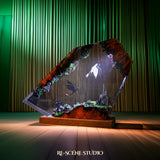
Here's where task and accent lighting overlap. A well-chosen decorative lamp serves both functions: it provides enough light to see by, and it adds visual interest to the room. Handcrafted lamps with built-in LED lighting are particularly effective because the resin or glass diffuses the light while creating a conversation piece.
For bedrooms, a warm-toned ambient lamp on a nightstand eliminates the need for harsh overhead light entirely. Many people who switch to bedside ambient lighting report sleeping better because they're not exposed to bright overhead light before bed. If you're interested in lamps that double as art pieces, our ambient lighting ideas guide covers options across every style and budget.

Layer 3: Accent Lighting (The Mood Maker)
Accent lighting is optional for function but essential for atmosphere. It's what transforms a well-lit room into a room that feels good to be in.
LED Strip Lights
LED strips behind a desk, under a bed frame, or along a bookshelf create a soft glow that adds depth to any room. A basic RGB strip costs $10 to $20 and covers about 16 feet. Smart strips from Govee or Philips Hue ($30 to $60) let you control color and brightness from your phone.
The most effective placement for LED strips is behind furniture rather than exposed on walls. Behind a headboard, under a floating shelf, or along the back edge of a desk creates a halo effect that makes the room feel larger than it is.
String Lights and Fairy Lights
Fairy lights aren't just for dorm rooms. Warm white micro-LED strings draped along a bookshelf or window frame add sparkle without the brightness of a primary light source. At $8 to $15, they're the cheapest way to add accent lighting. Choose battery-operated versions for maximum flexibility.

The $100 Budget Lighting Makeover
If you're starting from scratch in a room with no overhead light, here's exactly how to spend $100 for maximum impact:
$100 Lighting Plan for a Small Room
- Torchiere floor lamp ($30 to $45): General ambient light, replaces missing ceiling fixture
- Table or desk lamp ($20 to $35): Task lighting for reading or working
- LED strip ($10 to $20): Accent glow behind furniture
- Smart bulb ($10 to $15): Warm white for evening, cool for daytime, adjustable from phone
This setup gives you all three layers for under $100. The room will feel dramatically different from a single bare lamp in the corner. The key is spreading the light sources around the room rather than clustering them in one spot. For more ideas on transforming your room on a budget, see our guide on how to create a cozy bedroom on a $200 budget.
Common Mistakes to Avoid
Even with the right equipment, placement errors can ruin the effect. Here are the mistakes that waste money and leave rooms feeling wrong:
- Single light source syndrome. One bright lamp in the corner creates harsh shadows and leaves half the room dark. Always use at least two light sources on opposite sides.
- Too cool, too bright. Daylight bulbs (5000K+) in bedrooms feel sterile and make it harder to relax. Stick to 2700K to 3000K for any room where you unwind.
- Exposed bulbs without shades. An uncovered bulb creates glare and hard shadows. Always use a shade, diffuser, or opaque housing.
- All lights at the same height. If every lamp is on a nightstand, the room feels flat. Mix heights: one tall floor lamp, one mid-height table lamp, one low accent source.
- Ignoring dimming. A $5 inline dimmer on a lamp cord gives you full control over brightness. This single upgrade transforms any lamp from "on/off" to a real lighting tool.

Frequently Asked Questions
Featured Resin Lamps
Handcrafted with care, each one unique




Every lamp we create carries a piece of our heart: a small universe of light, resin, and imagination, handcrafted in our workshop for someone across the world who shares our love for these stories.