


![[FATHER'S DAY] Ember Glow Ticket | $6.68 — Handcrafted Epoxy Resin LED Lamp | Unique Ambient Decor & Collector's Gift](http://rescenestudio.com/cdn/shop/files/Lucky_Star_Ticket_NYE_2026_c61361fc-ea06-4a31-8379-e16ed7d47902.jpg?v=1767177179&width=320)


Godzilla Through the Ages: How the King of Monsters Evolved

Godzilla has been destroying cities on screen since 1954. In that time, the character has appeared in over 35 films, spawned a multimedia franchise worth billions, and evolved from a terrifying metaphor for nuclear destruction into everything from a children's cartoon hero to a world-ending force of nature. No other movie monster has been reinvented this many times while remaining culturally relevant.
If you're a newer fan who came in through the Monsterverse films (2014 onwards) and wonder why older fans treat Godzilla with almost religious reverence, this is the context you're missing. The King of Monsters isn't just a big lizard that fights other big lizards. He's a 70-year mirror reflecting whatever humanity fears most at any given moment.
The Original: Nuclear Horror (1954)
The first Godzilla film, released in 1954, was not an action movie. It was a horror film made by people who had lived through Hiroshima and Nagasaki. Director Ishiro Honda and producer Tomoyuki Tanaka created Godzilla as a direct metaphor for nuclear weapons: an unstoppable force awakened by atomic testing that lays waste to Tokyo while the government and military prove helpless.
The original film's tone is closer to a disaster drama than anything in the modern franchise. Characters debate the ethics of using a superweapon to kill Godzilla, mirroring real debates about nuclear proliferation. The scientist who creates the weapon ultimately destroys his research and sacrifices himself to prevent it from being used again. In 1954 Japan, nine years after the bombings, this wasn't entertainment. It was catharsis.
The film was a massive hit, earning the equivalent of $20 million in today's currency and becoming the eighth highest-grossing Japanese film of all time at that point. Godzilla immediately became a cultural icon, but the franchise's direction split almost immediately between serious drama and crowd-pleasing spectacle.

The Showa Era: Hero Turn (1955 to 1975)
The Showa era (named after the Japanese imperial period) spans 15 films and saw Godzilla transform from nuclear nightmare into something nobody expected: a hero. By the mid-1960s, Godzilla was fighting alien invaders, tag-teaming with other monsters, and even doing a victory dance after defeating King Ghidorah. The films became progressively campier, targeting younger audiences.
The most iconic Showa-era moments include Godzilla's first fight with King Kong (1962), the introduction of Mothra and Rodan as recurring allies, and the increasingly absurd "wrestler Godzilla" persona where the monster used drop kicks and tail slides against opponents. For purists, this era diluted the original's power. For millions of kids worldwide, this era made Godzilla lovable.
| Era | Years | Films | Godzilla's Role | Tone |
|---|---|---|---|---|
| Original | 1954 | 1 | Nuclear horror metaphor | Serious drama |
| Showa | 1955 to 1975 | 14 | Monster hero (mostly) | Campy to serious |
| Heisei | 1984 to 1995 | 7 | Force of nature | Serious sci-fi |
| Millennium | 1999 to 2004 | 6 | Varies (standalone films) | Mixed |
| Shin/Anime | 2016 to 2023 | 4 | Horror/existential threat | Serious to philosophical |
| Monsterverse | 2014 to 2026+ | 5+ | Alpha predator/protector | Blockbuster action |
The Heisei Era: Return to Darkness (1984 to 1995)
After a nine-year hiatus, Toho rebooted Godzilla in 1984 with "The Return of Godzilla," ignoring everything after the 1954 original. This Godzilla was terrifying again: a force of nature that couldn't be reasoned with, bargained with, or befriended. The Heisei era reintroduced scientific plausibility (within kaiju logic) and gave Godzilla a more animalistic, unpredictable characterization.
The era peaked with "Godzilla vs. Destoroyah" (1995), where Godzilla's nuclear heart goes into meltdown. He literally dies, his body glowing red and melting as he unleashes his remaining energy. Fans call it "Burning Godzilla," and it remains one of the franchise's most emotionally powerful moments. When the hardened kaiju-fighting military officers salute his body, even the most cynical viewer feels something.
Hollywood and the Monsterverse (2014 to Present)
Hollywood's first attempt at Godzilla (1998, Roland Emmerich) is widely considered a failure that missed what makes the character compelling. The design looked like a giant iguana. The monster was killable by missiles. It had none of the mythic weight that defines Godzilla.
Legendary Pictures' Monsterverse, starting with Gareth Edwards' "Godzilla" (2014), corrected course dramatically. This Godzilla is ancient, godlike, and operates on a scale that makes human military response irrelevant. The 2014 film's reveal of Godzilla's full size remains one of the great moments in blockbuster cinema: the camera pulls back, and back, and back, and the creature is still filling the frame.

"King of the Monsters" (2019) leaned into the mythological angle, framing Godzilla and the other Titans as ancient gods in a planetary ecosystem. "Godzilla vs. Kong" (2021) delivered on the promise of the franchise's two biggest icons fighting, and "Godzilla x Kong: The New Empire" (2024) pushed the buddy-movie dynamic even further. The Monsterverse has earned over $2 billion globally and shows no signs of stopping.
Shin Godzilla: The Best One You Haven't Seen (2016)
While Hollywood was building its Monsterverse, Toho released "Shin Godzilla" in Japan. Directed by Hideaki Anno (creator of Evangelion), it's arguably the best Godzilla film since the 1954 original. Shin Godzilla reimagines the creature as a constantly mutating organism that evolves in real-time, starting as a barely functional sea creature and ending as a towering nightmare that freezes Tokyo with atomic breath.
The film is primarily a satire of Japanese bureaucratic response to disasters (directly inspired by the 2011 Fukushima nuclear disaster). While Godzilla destroys Tokyo, the government holds meetings about holding meetings. The real monster isn't Godzilla; it's institutional paralysis. The film grossed $78 million in Japan and won the Japanese Academy Prize for Best Picture, a first for any Godzilla film.
Godzilla Minus One: The Oscar Winner (2023)
Just when the franchise seemed locked into its Monsterverse blockbuster lane, Toho released "Godzilla Minus One," a post-WWII period film that became the first Godzilla movie to win an Academy Award (Best Visual Effects). Set in 1947 Japan, it follows a disgraced kamikaze pilot who encounters Godzilla during the country's most vulnerable moment.
The film earned $116 million worldwide on a $15 million budget, making it the most profitable Godzilla film in franchise history. Critics praised it for returning to the character's emotional roots while delivering visual effects that rivaled Hollywood productions costing ten times as much. For many viewers, it's the definitive answer to "can a Godzilla movie make you cry?"
Why Godzilla Endures
Most movie monsters from the 1950s are forgotten. Godzilla isn't. The character's longevity comes from adaptability. Each generation gets the Godzilla it needs: nuclear horror for post-war Japan, campy fun for 1960s kids, dark sci-fi for 1980s teens, disaster allegory for post-Fukushima adults, and blockbuster spectacle for the global streaming era.
The design itself is brilliant in its simplicity. Upright posture, dorsal plates, atomic breath. Three elements that remain recognizable whether rendered in rubber suits, CGI, anime, or handcrafted art. Godzilla's silhouette is as instantly readable as Batman's or Mickey Mouse's. If you enjoy deep-dives into franchise lore, check out our Demon Slayer Breathing Styles guide and One Piece Devil Fruit breakdown for similar analysis.
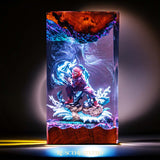
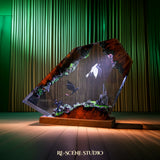
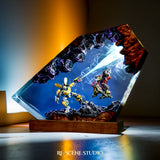
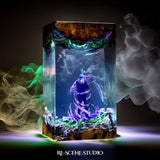
For fans who want a piece of the King of Monsters on their desk, our artisan workshop handcrafts Godzilla resin lamps that capture the kaiju's iconic presence with embedded LED lighting. Each piece takes days to complete, and the resin layering creates depth that flat prints and figures can't match.


Frequently Asked Questions
Featured Resin Lamps
Handcrafted with care — each one unique


Every lamp we create carries a piece of our heart — a small universe of light, resin, and imagination, handcrafted in our workshop for someone across the world who shares our love for these stories.