




Every Breathing Style in Demon Slayer Explained and Ranked

Demon Slayer's breathing styles are the backbone of every fight in the series. There are 14 distinct styles in total, each derived from a single origin technique that predates the Demon Slayer Corps itself. But most fans only know 5 or 6 of them well. The rest live in manga panels, databooks, and lore that the anime has not fully adapted yet.
This guide covers all 14 breathing styles in Demon Slayer, explains how each one works, names the known users, and ranks them from least to most powerful. Whether you have finished the manga or are still watching the anime, this breakdown will give you a complete picture of how the breathing system connects together.
How Breathing Styles Work in Demon Slayer
Breathing styles are combat techniques that enhance a Demon Slayer's physical abilities by controlling their breathing patterns. The concept is based on Total Concentration Breathing, where a slayer inhales maximum air and concentrates oxygen flow to specific muscles. This temporarily boosts strength, speed, and reflexes to superhuman levels.
Every breathing style produces a visual element effect (water, fire, lightning) when used, but these are NOT actual elemental attacks. The water you see during Tanjiro's Water Breathing is a visual representation of his sword technique, not real water. Koyoharu Gotouge confirmed this in Volume 6's author notes. The only exception is Sun Breathing, which some fans theorize produces actual heat through friction.
All 14 breathing styles trace back to one original technique: Sun Breathing, created by Yoriichi Tsugikuni in the Sengoku era. The five core derivatives (Water, Flame, Wind, Stone, Thunder) were adapted by Yoriichi's students who could not master Sun Breathing directly. The remaining styles branched from these five over centuries.
The Breathing Style Family Tree
| Origin | Core Style | Derived Styles |
|---|---|---|
| Sun Breathing | Water | Flower → Insect, Serpent |
| Flame | Love | |
| Wind | Mist, Beast | |
| Stone | (none) | |
| Thunder | Sound |
Moon Breathing is a special case. It was created by Kokushibo (Upper Moon One), who was Yoriichi's twin brother. It is not a derivative of any core style; it is a corrupted version of Sun Breathing itself, adapted after Kokushibo became a demon.
All 14 Breathing Styles, Ranked
This ranking considers raw power, versatility, known forms, and combat results shown in the manga. Anime-only viewers: mild spoilers ahead for the Hashira Training and Infinity Castle arcs.
14. Flower Breathing
Derived from Water Breathing. Known users: Kanae Kocho (former Flower Hashira) and Kanao Tsuyuri. Flower Breathing emphasizes graceful, precise movements that target vital points. It has 7 known forms, with the Final Form (Equinoctial Vermilion Eye) being a last-resort technique that enhances the user's dynamic vision at the cost of potential blindness.
Kanao's use of the Final Form during the fight against Doma (Upper Moon Two) was one of the most emotionally intense moments in the manga. She sacrificed the vision in one eye to land the critical blow. Ranked 14th because it has fewer combat applications than most styles and only two known users.
13. Insect Breathing
Derived from Flower Breathing (making it two generations removed from Water). Created and solely used by Shinobu Kocho. Insect Breathing is unique because Shinobu lacks the physical strength to decapitate demons. Instead, she developed a style that focuses entirely on stabbing and injecting wisteria-based poison through her modified blade.
This makes Insect Breathing the most specialized style in Demon Slayer. It is devastatingly effective against weaker demons but has a hard ceiling against Upper Moons with poison resistance. Shinobu knew this, which is why her final strategy against Doma was to turn her entire body into poison over two years. Brilliant, tragic, and ranked 13th for its narrow application.
12. Serpent Breathing
Derived from Water Breathing. Used exclusively by Obanai Iguro, the Serpent Hashira. Serpent Breathing uses a twisted, wavy blade to deliver slashes that follow unpredictable curved trajectories, like a striking snake. It has 5 known forms.
Obanai's combat performance during the Infinity Castle arc proved Serpent Breathing is stronger than its lower profile suggests. He fought alongside Tanjiro against Muzan himself. Ranked 12th because it has fewer forms and only one user, but its actual combat ceiling is higher than its reputation.
11. Love Breathing
Derived from Flame Breathing. Created by Mitsuri Kanroji, the Love Hashira. Love Breathing uses Mitsuri's unique physical trait (muscles 8x denser than normal) to wield a flexible, whip-like blade with incredible speed. The style has 6 known forms and emphasizes wide, sweeping attacks that cover large areas.
Mitsuri held her own against Hantengu's Zohakuten form (Upper Moon Four's merged state) for an extended period, which is a serious feat. Ranked 11th because, while powerful, it is entirely dependent on Mitsuri's unique physiology and cannot be taught to other slayers.
Mitsuri's backstory explains why Love Breathing exists at all. She originally trained under Rengoku using Flame Breathing but found that her flexible muscles and quick reflexes suited a different approach. She adapted Flame's aggressive philosophy into something that matched her body type, creating an entirely new style. This makes Love Breathing one of only three styles (alongside Beast and Moon) invented by the user rather than inherited from a lineage.
10. Sound Breathing
Derived from Thunder Breathing. Created by Tengen Uzui, the Sound Hashira. Sound Breathing uses explosive detonations and rhythmic patterns to overwhelm opponents. Tengen's Musical Score technique reads an opponent's attack patterns like sheet music, predicting their movements.
Tengen is one of the physically strongest Hashira and his fight against Gyutaro (Upper Moon Six) was a showcase of endurance and tactical brilliance. He fought while poisoned and missing a hand. Ranked 10th because Sound Breathing has only 5 known forms and its Musical Score requires extended combat time to activate.
Tengen's approach to combat is worth examining further. He is the only Hashira who explicitly treats demon-slaying as a performance rather than a duty. His flashy fighting style, dual-wielding nichirin cleavers, and use of small explosives make Sound Breathing the most theatrical style in the Corps. He retired after the Entertainment District arc, making him the only Hashira to survive retirement during the story's timeline.
9. Beast Breathing
Derived from Wind Breathing (self-taught). Created by Inosuke Hashibira, who developed it by growing up in the mountains with boars. Beast Breathing is wild, unpredictable, and relies on Inosuke's heightened sense of touch to detect air currents and predict attacks.
What makes Beast Breathing fascinating is that it is entirely self-invented. Inosuke never had a teacher. He created all 11 forms (the most of any non-core style) through pure instinct and survival. His Spatial Awareness technique lets him detect anything within his vicinity through vibrations. Ranked 9th for its creativity, though it lacks the refined power of trained styles.
What sets Beast Breathing apart is its philosophical contrast with every other style. All other breathing techniques are passed down through formal training, master to student, generation to generation. Beast Breathing proves that raw talent and survival instinct can produce something entirely original. Inosuke's 11 forms include techniques no other slayer could replicate because they require his unique double-jointed flexibility and boar-enhanced reflexes.
8. Mist Breathing

Derived from Wind Breathing. Used by Muichiro Tokito, the Mist Hashira. Mist Breathing uses swift, disorienting movements that obscure the user's position, making their attacks appear to materialize from thin air. It has 7 forms, including an original 7th form (Obscuring Clouds) that Muichiro created himself.
Muichiro became a Hashira at age 14, only two months after picking up a sword. He is a confirmed descendant of Kokushibo (Upper Moon One), which explains his prodigious talent. He single-handedly defeated Gyokko (Upper Moon Five) after unlocking his Demon Slayer Mark. Ranked 8th for its speed and deception, though it relies heavily on the user's natural talent.
7. Thunder Breathing

One of the five core styles. Thunder Breathing focuses on explosive bursts of speed concentrated in the legs. It has 6 forms, with the First Form (Thunderclap and Flash) being the most famous technique in the entire series. Zenitsu Agatsuma can only use this one form, but he perfected it to a degree that surpasses most Hashira-level slayers.
Zenitsu created his own 7th Form (Honoikazuchi no Kami) that he used to defeat Kaigaku (Upper Moon Six replacement) in a single strike. The fact that Zenitsu, who could only use one form, became strong enough to fight Upper Moons proves that mastery of a single technique can outweigh breadth of knowledge. Thunder Breathing rewards commitment over versatility.
6. Wind Breathing

One of the five core styles. Wind Breathing uses powerful, sweeping attacks that generate cutting gale-force winds. It has 9 forms, the most of any core style. Sanemi Shinazugawa, the Wind Hashira, is one of the most battle-hardened slayers in the Corps, having fought demons since childhood after his mother was turned.
Sanemi's rare Marechi blood (blood that is intoxicating to demons) gives him a unique tactical advantage. During the Infinity Castle arc, he fought Kokushibo (Upper Moon One) alongside Gyomei and survived, which puts him in extremely elite company. Wind Breathing ranks 6th for its raw offensive power and Sanemi's unmatched combat experience.
5. Water Breathing
The most widely used breathing style and the one most commonly taught to new slayers. Water Breathing has 11 forms (10 standard plus Tanjiro's self-created 11th form), making it the most versatile core style. Its movements are fluid and adaptable, working equally well in offense and defense.
Giyu Tomioka, the Water Hashira, created the 11th Form (Dead Calm), which nullifies all attacks within its range by intercepting incoming blows with imperceptible counter-movements. It is arguably the strongest defensive technique in the entire series, stopping Rui's threads and even Akaza's Annihilation Type attacks momentarily.
Tanjiro used Water Breathing for the majority of the series, from his earliest training under Sakonji Urokodaki through the Entertainment District arc. His transition to Sun Breathing was gradual, mixing Water and Hinokami Kagura forms depending on the opponent. The 10th Form (Constant Flux) is particularly effective because its power increases with each consecutive rotation, meaning the longer a fight goes, the stronger it becomes.
Water Breathing is also the most commonly taught style because its fluid movements are forgiving to beginners. New recruits who survive Final Selection most frequently use Water forms. Ranked 5th because its versatility makes it the best all-rounder for both offense and defense, even if it lacks the raw destructive ceiling of Flame or Stone. For fans interested in how the different Hashira styles compare, our deep lore breakdowns cover similar power system analysis across other franchises.
4. Stone Breathing
The most physically demanding core style. Stone Breathing uses a spiked flail and axe connected by a chain, requiring immense upper body strength. It has 5 forms, the fewest of any core style, but each form delivers devastating impact.
Gyomei Himejima, the Stone Hashira, is unanimously considered the strongest active Hashira by every other pillar. At 220 cm (7 feet 2 inches) tall, he is physically the largest Demon Slayer in the Corps. His weapon is unique: a spiked flail and axe connected by a chain, which no other breathing style uses. This requires immense arm strength and spatial awareness that most slayers cannot develop.
Kokushibo himself (Upper Moon One, a 400-year-old demon) acknowledged Gyomei as the strongest human warrior he had encountered in centuries. During their fight in the Infinity Castle, Gyomei was the first to awaken the Transparent World without any prior guidance, a feat that required absolute concentration and physical mastery. He fought Kokushibo head-on and landed critical hits that contributed to the Upper Moon's eventual defeat.
Gyomei's backstory also adds depth to his strength. He was blind since birth and developed his combat abilities entirely through hearing and vibration. Stone Breathing's emphasis on ground-based attacks and weighted strikes complements his heightened non-visual senses. Ranked 4th because despite having fewer forms than other core styles, the sheer power ceiling is unmatched among human fighters.
3. Flame Breathing

Flame Breathing is one of the five core styles and has been passed down through the Rengoku family for generations. It has 9 forms, with the Ninth Form (Rengoku) being the family's ultimate technique, named after the style itself. Flame Breathing generates intense heat through rapid slashing motions and is one of the most offensively focused styles.
Kyojuro Rengoku's fight against Akaza (Upper Moon Three) on the Mugen Train remains the single most iconic fight in Demon Slayer. Rengoku pushed Akaza to the point where the Upper Moon had to use his strongest techniques, and Akaza himself admitted that Rengoku's skill was approaching the realm of the "Transparent World." For a human with no Demon Slayer Mark, that is extraordinary.
What makes this fight work narratively is the asymmetry. Akaza can regenerate infinitely. Rengoku cannot. Every wound Rengoku takes is permanent. Every wound Akaza takes heals in seconds. The fight is not about who is more skilled; it is about how long a mortal can hold his ground against infinity. The answer, in Rengoku's case, was until dawn.
Flame Breathing's combat philosophy mirrors this perfectly. It is aggressive, forward-moving, and unyielding. There are no defensive forms in Flame Breathing. Every technique pushes forward. Rengoku's father abandoned the sword, but Rengoku chose to carry the legacy alone, reading the Flame Hashira records and teaching himself the advanced forms. That self-driven mastery is part of why fans connect with him so deeply.
That battle captured everything fans love about the series: sacrifice, willpower, and the gap between mortal and immortal. It is also the moment that made Rengoku the most beloved character in the franchise. His final words to Tanjiro, "set your heart ablaze," became the emotional core of the entire story.

2. Moon Breathing

Moon Breathing is the only style created by a demon. Kokushibo (born Michikatsu Tsugikuni) was Yoriichi's twin brother and an extremely talented swordsman in his own right. After failing to master Sun Breathing and becoming consumed by jealousy, he turned himself into a demon to gain eternal life and centuries of practice time.
Moon Breathing has 16 forms, the most of any breathing style. Its crescent-shaped slashes are uniquely dangerous because they can change trajectory mid-flight and multiply into smaller blades. During the Infinity Castle arc, Kokushibo fought Muichiro, Genya, Sanemi, and Gyomei simultaneously, and it took all four of them to bring him down.
Ranked 2nd because Moon Breathing combines 400 years of refinement with demon physiology. The only reason it does not claim the top spot is that it is fundamentally a lesser copy of the style above it, and Kokushibo himself knew this.
1. Sun Breathing (Hinokami Kagura)

Sun Breathing is the original breathing technique, created by Yoriichi Tsugikuni during the Sengoku era. Every other breathing style in existence is a derivative or adaptation of Sun Breathing. It has 13 forms that, when performed in sequence, create an endless loop called the "Thirteenth Form," which is the only technique capable of truly threatening Muzan Kibutsuji.
Yoriichi is, canonically, the most powerful character in Demon Slayer's history. He cornered Muzan in a single encounter and came within seconds of killing him. Muzan was so traumatized by this fight that the memory of Yoriichi triggered cellular-level fear responses centuries later. No other character, human or demon, inspired that level of dread in the Demon King.
Tanjiro inherited Sun Breathing through the Hinokami Kagura, a ritual dance passed down through the Kamado family for generations. His father, Tanjuro, performed the dance every year from sunset to sunrise without rest, demonstrating the breathing technique's connection to endurance and continuous flow.
In the final battle against Muzan, Tanjiro used Sun Breathing's Thirteenth Form to keep Muzan at bay until sunrise. The style's power lies not in individual forms but in the continuous, unbroken cycle of all 13 forms together. It is both the beginning and the pinnacle of the Demon Slayer breathing system.
The Complete Breathing Style Ranking
| Rank | Breathing Style | Origin | Known Forms | Notable User |
|---|---|---|---|---|
| 1 | Sun Breathing | Original | 13 (+loop) | Yoriichi Tsugikuni |
| 2 | Moon Breathing | Sun (corrupted) | 16 | Kokushibo |
| 3 | Flame Breathing | Sun (core) | 9 | Rengoku Kyojuro |
| 4 | Stone Breathing | Sun (core) | 5 | Gyomei Himejima |
| 5 | Water Breathing | Sun (core) | 11 | Giyu Tomioka |
| 6 | Wind Breathing | Sun (core) | 9 | Sanemi Shinazugawa |
| 7 | Thunder Breathing | Sun (core) | 7 | Zenitsu Agatsuma |
| 8 | Mist Breathing | Wind | 7 | Muichiro Tokito |
| 9 | Beast Breathing | Wind (self-taught) | 11 | Inosuke Hashibira |
| 10 | Sound Breathing | Thunder | 5 | Tengen Uzui |
| 11 | Love Breathing | Flame | 6 | Mitsuri Kanroji |
| 12 | Serpent Breathing | Water | 5 | Obanai Iguro |
| 13 | Insect Breathing | Flower | 4 | Shinobu Kocho |
| 14 | Flower Breathing | Water | 7 | Kanao Tsuyuri |
Why the Breathing System Works So Well
Demon Slayer's power system succeeds where many shonen series fail because it has clear rules, hard limits, and meaningful trade-offs. A Demon Slayer cannot simply train harder and unlock unlimited power. Total Concentration Breathing has a biological ceiling determined by lung capacity, muscle density, and innate talent.
The Demon Slayer Mark can push a fighter beyond their normal limits, but it comes with a death sentence: every marked slayer in history died before age 25 (with only Yoriichi as the exception). This means power has a cost. Even the Hashira, the strongest humans alive, are still mortal. They bleed, tire, and die. That vulnerability is what makes every fight feel consequential.
Compare this to other shonen power systems. In Naruto, chakra can scale infinitely through Sage Mode, Tailed Beast power, and eventually god-level abilities. In Dragon Ball, power levels have no meaningful ceiling. Demon Slayer deliberately avoids this trap. The strongest human who ever lived (Yoriichi) still could not kill Muzan in their encounter. Power has limits, and those limits create drama.
The fact that all styles trace back to one source (Sun Breathing) also creates a satisfying narrative structure. It means the entire Corps is using diluted versions of a technique that one man mastered perfectly. The story is, in a sense, about chasing a standard that can never be fully reached again. That is what gives Yoriichi's legacy its weight and Tanjiro's journey its purpose.
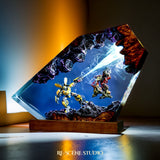
For fans who want to keep this legacy close, the characters and their breathing styles have been captured in handcrafted collectibles that bring these iconic moments to life. Rescene Studio's artisans spend weeks crafting each piece by hand, freezing these battle scenes inside illuminated resin.

The breathing system is one of many reasons Demon Slayer became a cultural phenomenon. Its rules are simple enough for casual viewers to follow but deep enough for fans to analyze endlessly. If you enjoyed this breakdown, our guide to hidden details in Studio Ghibli films applies the same deep analysis to another beloved anime studio.
Frequently Asked Questions
Featured Resin Lamps
Handcrafted with care, each one unique
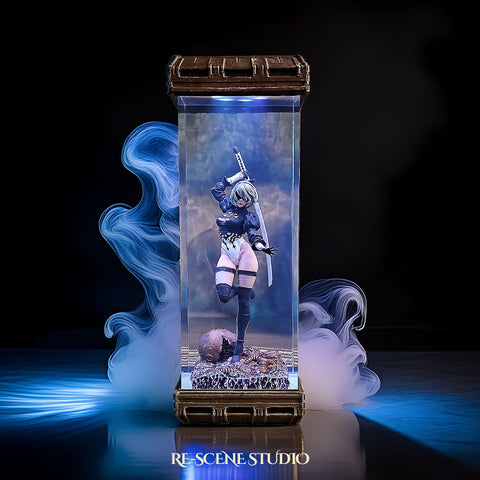
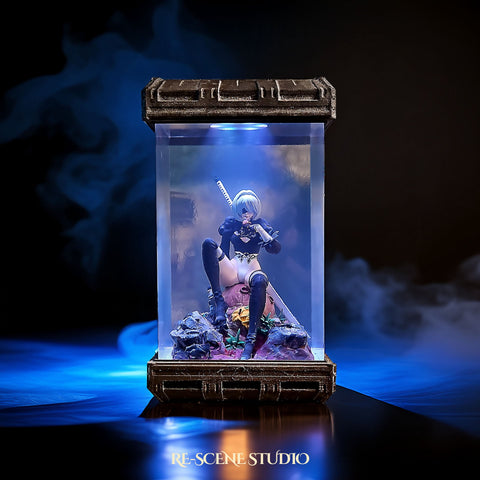
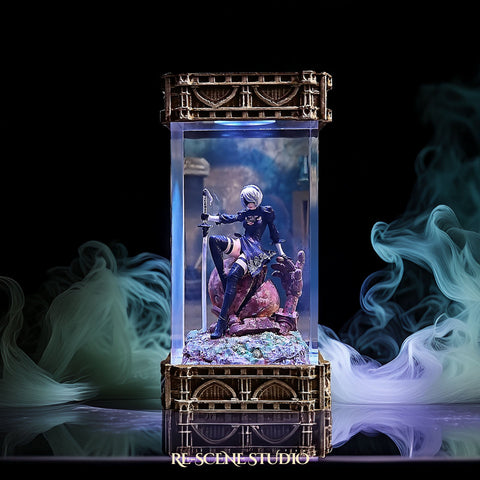
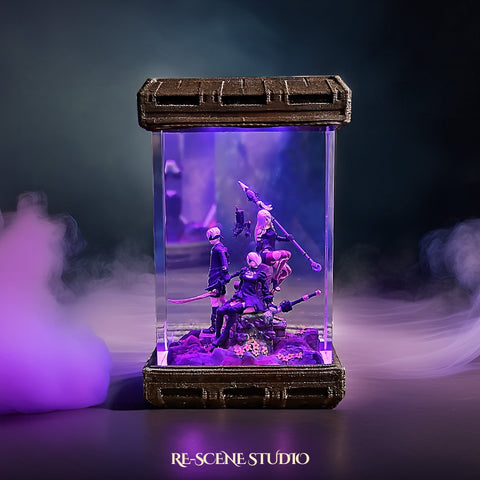
Every lamp we create carries a piece of our heart: a small universe of light, resin, and imagination, handcrafted in our workshop for someone across the world who shares our love for these stories.