






Bring the Outdoors In: 8 Nature-Inspired Home Lighting Ideas

Most people who want a more natural-feeling home go straight to plants. They add a fiddle-leaf fig, a snake plant, a trailing pothos. And those help. But the single biggest change you can make to a room's feel has nothing to do with what you put on the surfaces. It's what you do with the light.
Lighting is the invisible layer of interior design. The right light source makes wood look richer, textiles look softer, and the air in a room feel different. The wrong light makes even a beautifully decorated space feel sterile. Nature-inspired home decor starts with understanding this, and adjusting your lighting before you buy another plant or piece of furniture.
Here are 8 practical, actionable ways to use light to bring the outdoors into any room, whether you rent or own, whether your budget is $20 or $200.
1. Switch to Warm White Bulbs Across Every Room
The single most impactful change you can make costs under $15 and takes ten minutes. Replace any cool white or daylight bulbs (5000K-6500K) with warm white equivalents in the 2700K-3000K range.
Cool white light mimics overcast midday sky. It's fine for offices and bathrooms where clarity matters. But it strips warmth from wood, neutralizes the depth of natural fabrics, and makes green plants look flat. Warm white light, by contrast, mimics golden hour and late afternoon sun: the light that makes forests and gardens feel alive. It deepens wood grain, makes textiles look inviting, and brings out the warmth in stone and terracotta.
If you want to go one step further, look for bulbs labeled "soft white" or "amber" at 2700K. These sit at the warmest end of the spectrum and create an evening campfire quality. Brands like Philips, GE Lighting, and IKEA all carry affordable options in this range.
| Color Temp | Warmth Feel | Best Room Use | Nature Vibe |
|---|---|---|---|
| 2700K (soft white) | Candlelight amber | Bedrooms, living rooms | Excellent: golden hour quality |
| 3000K (warm white) | Warm, inviting | Most living spaces | Good: late afternoon feel |
| 4000K (neutral white) | Clean, balanced | Kitchens, workspaces | Neutral: works in daylight contexts |
| 5000-6500K (daylight) | Cool, clinical | Offices, bathrooms only | Poor: actively fights nature vibe |
For more on how color temperature affects the feel of every room, our guide on lighting mistakes that make rooms look cheap covers the most common errors people make when choosing bulbs and fixtures.
2. Place Light Sources Low: At Floor and Surface Level
In nature, light rarely comes from directly above. Sunlight arrives at angles. Campfires sit at ground level. The moon casts long shadows from above but still feels horizontal rather than vertical. Overhead lighting fights this instinct.
For a more nature-inspired feel, reduce your reliance on ceiling fixtures and add light sources that sit at surface level or below: table lamps, floor lamps angled upward, LED strips placed beneath furniture, or small accent pieces on shelves and consoles.
The difference is striking. Overhead light flattens a room and creates institutional associations (schools, offices, hospitals all use overhead lighting). Low-level light creates depth and shadow, the visual vocabulary of natural environments where light filters through canopy and hits surfaces at angles rather than beating down from above.
3. Layer at Least Three Light Sources Per Room
Professional interior designers talk about the three-layer lighting model: ambient (general illumination), task (directed work light), and accent (decorative). In nature-inspired rooms, the accent layer is where the character lives.
A floor lamp behind an armchair. A small table lamp on a console. A dedicated accent piece on a bookshelf. Three sources at different heights create the kind of visual complexity you'd find in a forest at dusk: pools of warm light with gradients of shadow between them.
The goal is not to eliminate darkness from a room. It's to let darkness exist alongside warmth, the way an evening garden or a forest clearing works at the hour before sunset. If your room looks like a uniformly illuminated waiting room at night, you have too few layers.
Our post on making any room feel cozy on a budget goes deeper on the layering technique with specific furniture placement suggestions.
4. Choose Nature-Scene Accent Pieces for Ambient Glow
Once you have your base lighting sorted (warm temperature, low placement, layered sources), the accent pieces you choose become the storytelling layer. This is where nature-inspired lighting moves from technique to atmosphere.
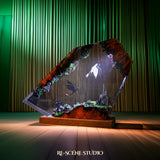
Nature scene resin pieces work well here because they use light from within rather than projecting it outward. The warm LED inside illuminates the resin from the inside, so the scene, whether a deep green forest, a moonlit field, or a deer in snow, appears to be lit by a natural ambient source. The result is a small landscape that seems to glow from within, like sunlight on a frosted window or firelight through a tree line.

Pair this type of accent piece with a wood shelf, a linen runner, and a small trailing plant beside it. The combination reads as a curated natural vignette rather than a collection of random objects.
5. Use Plants as Light Diffusers, Not Just Decoration
Most people put plants in bright spots where they can be seen. A more effective technique is placing plants near a backlit corner or behind a light source, so the light filters through the leaves and creates dappled shadow patterns on nearby walls.
A monstera or bird of paradise placed one to two feet in front of a warm floor lamp creates a natural shadow projection that moves slightly with air movement from vents or windows. The effect is subtle but immediate: the room suddenly has the quality of light beneath a tree canopy. No painter or projector needed.
For this to work, choose plants with interesting leaf shapes rather than fully compact forms. Monstera deliciosa, fiddle-leaf fig, and even large pothos trained up a pole all create good shadow patterns. Place the light source directly behind or slightly beneath the plant's canopy, angled upward.
6. Build a Moonlight Palette for Your Bedroom
Forest light in daylight is warm and golden. Forest light at night is cool and silver. A nature-inspired bedroom that feels peaceful at night leans into the moonlight palette: soft blue-whites, silver metallics, and the deep green of nighttime foliage.

This doesn't mean cool-white LEDs, which are too harsh for a sleeping environment. Instead, use dimmable warm white bulbs turned to their lowest setting, which shifts toward amber. Pair with cooler-toned textiles (grey-blues, sage green, dusty teal) and accent pieces with a moonlit aesthetic.
The Moonlight Forest resin piece works particularly well in a bedroom corner for exactly this reason: the amber glow inside the resin creates the contrast of warm inner light against a cold, wintry forest scene, the visual of firelight in the dark woods.

7. Recreate the Golden Hour Effect with Warm Accent Lighting
Golden hour, the 30-60 minutes after sunrise and before sunset, is when natural light is at its most visually pleasing. Photographers chase it because it creates depth, warmth, and softness that harsher daylight can't replicate. You can simulate it indoors with the right combination of warm light sources and natural colors.
The key elements: amber-yellow tone (2700K), light arriving from the side rather than above, and warm surface colors (honey wood, terracotta, wheat linen) that amplify the golden quality. Add a sunflower or yellow floral accent piece to the setup and the effect becomes immediately recognizable as a golden-hour scene.

A sunflower glow resin piece on a warm-wood console, paired with a dimmable amber floor lamp angled toward the wall, can create this effect in a corner of a living room or bedroom. The lamp inside the resin piece adds the quality of light catching translucent petals, which is remarkably close to actual sunflowers in afternoon light.

8. Use Texture to Make Light Behave Like Nature
Smooth, flat surfaces (white walls, glass, glossy furniture) reflect light uniformly and create an even, slightly clinical look. Natural environments are textured: bark, leaves, moss, water, stone all scatter and absorb light differently at every point.
Introducing texture into your room changes how light behaves. A rough-woven linen curtain softens incoming sunlight. A jute rug scatters the glow from a floor lamp into hundreds of small reflections. A ceramic vase with an uneven glaze creates shadow variation. A wooden shelf with visible grain absorbs some light and reflects the rest at slight angles, creating depth that painted MDF cannot match.
You don't need to redecorate. Adding a single textured element near your key light source changes the quality of light in that area significantly. A rattan lampshade on an existing floor lamp is often enough to convert a flat wash of light into something dappled and interesting. The goal is always to make light behave more like it would outdoors, where it never hits a perfectly uniform surface.
Frequently Asked Questions
Featured Resin Lamps
Handcrafted with care, each one unique


Every lamp we create carries a piece of our heart: a small universe of light, resin, and imagination, handcrafted in our workshop for someone across the world who shares our love for these stories.