




![[FATHER'S DAY] Ember Glow Ticket | $6.68 — Handcrafted Epoxy Resin LED Lamp | Unique Ambient Decor & Collector's Gift](http://rescenestudio.com/cdn/shop/files/Lucky_Star_Ticket_NYE_2026_c61361fc-ea06-4a31-8379-e16ed7d47902.jpg?v=1767177179&width=320)


What Is CRI in Lighting and Why It Matters

You bought new LED bulbs, screwed them in, and something feels off. The room looks flat. Your colorful throw pillows look grayish. Your skin looks sallow in the bathroom mirror. The brightness is fine, so what went wrong?
The answer is CRI, or Color Rendering Index. It's the single most overlooked spec on every light bulb box, and it affects how every color in your home actually looks to your eyes. Most people shop by brightness (lumens) and color temperature (warm vs cool), but CRI is what separates a room that feels alive from one that feels like a hospital waiting area.
What Is CRI? The 10-Second Explanation
CRI measures how accurately a light source shows true colors compared to natural sunlight. It's a score from 0 to 100, where 100 means colors look exactly as they would under perfect daylight. A CRI of 80 means colors are 80% accurate. Below 80, you'll start noticing things look "off" without being able to pinpoint why.
Think of it this way: a CRI of 100 is noon sunlight on a clear day. Every red is vivid red, every green is rich green. Drop to CRI 70 (common in cheap LEDs and fluorescent tubes), and those same colors become muted, dull versions of themselves. Your navy shirt looks black. Your carefully chosen wall paint looks like a different shade entirely.

CRI 80 vs 90 vs 95+: What You'll Actually Notice
The jump from 70 to 80 is dramatic. Going from 80 to 90 is subtler but still visible in daily life. Here's what each range feels like in practice:
| CRI Range | What You'll See | Where You'll Find It | Price Impact |
|---|---|---|---|
| Below 70 | Colors look gray and lifeless. Skin tones appear sickly. | Old fluorescent tubes, very cheap LEDs | Cheapest |
| 70-79 | Acceptable but flat. Reds and warm tones suffer most. | Basic commercial LEDs, garage lighting | Budget |
| 80-89 | Good for most rooms. Colors are reasonably accurate. | Standard home LEDs (most big brands) | Mid-range |
| 90-95 | Excellent. Subtle color differences become visible. Skin looks natural. | Premium home LEDs, photography studios | +15-30% over CRI 80 |
| 95-100 | Near-perfect. Art galleries, makeup counters, fine dining. | Specialty bulbs, high-end track lighting | Premium |
The practical cutoff for most people: if a room has decorative objects, artwork, plants, or anything where color matters, aim for CRI 90+. If it's a garage or utility closet, CRI 80 is fine.
One honest caveat: not everyone can perceive the difference between CRI 90 and 95. If you're not particularly color-sensitive, CRI 90 is the sweet spot between "looks great" and "doesn't cost a fortune." Save CRI 95+ for your bathroom mirror and any room where you evaluate colors (choosing outfits, applying makeup, painting).
Where High CRI Matters Most in Your Home
Not every room needs premium CRI. Here's where to invest and where to save:
Invest in CRI 90+ Here
- Bathroom vanity: You make skin-tone decisions here daily. Low CRI means your makeup looks different at the office.
- Kitchen counters: You need to see if meat is cooked, if avocados are ripe, if herbs are fresh.
- Living room / bedroom accent lighting: This is where your decor lives. Art, plants, colored textiles all need accurate light to shine.
- Home office: Eye fatigue increases under low CRI light because your brain works harder to interpret colors.
- Display shelves: Collectibles, figurines, and handcrafted pieces deserve light that shows their true detail.
That last point matters especially for handcrafted decor. Pieces with fine color gradients, like a hand-painted sculpture or a resin piece with layered pigments, can look completely different under CRI 80 vs CRI 95. The green of a forest scene shifts from rich emerald to muddy olive. The orange of a sunset diorama fades to brown.

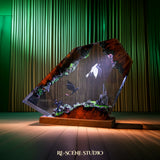
A piece like this Sunflower Glow lamp has warm amber gradients that look completely different depending on the CRI of your room lighting. Under CRI 95, every petal shade is distinct. Under CRI 75, it flattens into a single yellowish blob. If you own colorful decor, the light around it matters as much as the piece itself.

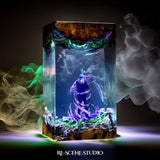
Same principle with this forest scene. The layered greens, from dark pine to bright moss, only separate properly under high CRI light. Under poor lighting, the entire diorama reads as one flat green block. This is true for any decor with subtle color work: paintings, glass art, ceramics, or resin craft.

How to Check a Bulb's CRI Before You Buy
Here's the frustrating reality: most bulb packaging buries CRI in tiny print, if they list it at all. Some brands don't print it on the box. Here's how to find it:
In-store: Look for "CRI" or "Ra" on the Lighting Facts panel (the nutrition-label-style box on the side). If you can't find it, the bulb is probably CRI 80 or below. Brands that hit CRI 90+ tend to advertise it because it's a selling point.
Online: Check the product specifications tab. Search for "CRI," "Color Rendering," or "Ra." If the listing doesn't mention CRI anywhere, assume it's 80. No brand hides a CRI 95 rating.
Brands known for high CRI (90+): Philips (their "SceneSwitch" and premium lines), Cree (TrueWhite series), Waveform Lighting (specializes in high CRI), Yuji LED, and Soraa. Standard IKEA and Amazon Basics bulbs are typically CRI 80-82.

CRI vs Color Temperature: They're Not the Same Thing
A common confusion: people swap "warm light" with "good light." They're separate measurements. Color temperature (measured in Kelvin) determines whether light looks warm-yellow (2700K) or cool-blue (5000K). CRI determines whether colors look accurate regardless of warmth.
You can have a warm 2700K bulb with terrible CRI 70 (colors look dull and orange-shifted) or the same 2700K with CRI 95 (colors look rich and accurate with a warm cast). The warmth is the same; the color accuracy is different. If you've read our guide to lighting mistakes that make rooms look cheap, low CRI is one of the most common culprits.
Similarly, if you've invested in decor pieces with intricate color work, it's worth understanding why handcrafted items look different under different lights. The science behind pigment layering means some details literally disappear under low CRI conditions.
Quick Action Plan: Upgrading Your Color Rendering
You don't need to replace every bulb at once. Start with the rooms where you spend the most time looking at colors:
- Step 1: Check the color rendering rating of your current bathroom and kitchen bulbs. If below 90, these are your first upgrades.
- Step 2: Replace your bedside and living room accent bulbs next. These illuminate your decor and influence how your room "feels" in the evening.
- Step 3: Leave utility spaces (garage, laundry, closets) for last. A score of 80 is fine where color accuracy doesn't matter.
- Step 4: When buying new bulbs, filter online searches by "90+ color rendering" or "high color accuracy LED." The price difference is often just $2-4 per bulb for a visible quality jump.
One last tip: if you use smart bulbs (Philips Hue, LIFX), check their color rendering at different color temperatures. Some smart bulbs perform well at 3000K but drop significantly when you shift to cooler temperatures. The spec sheet rating is usually measured at one temperature only.
Common Myths About Color Rendering Index
Since this topic sits at the intersection of physics and marketing, misinformation is everywhere. Let's clear up the biggest myths:
Myth: "Warm light always has better color accuracy." False. Warmth (Kelvin) and color accuracy (the rendering score) are independent measurements. A warm 2700K bulb can have a terrible score of 70 or an excellent score of 97. You need to check both specs separately.
Myth: "LEDs always have worse color rendering than incandescent bulbs." Partially true historically, but modern premium LEDs regularly hit 95+, matching or exceeding old incandescent bulbs. The technology caught up years ago; you just have to look past the cheapest options on the shelf.
Myth: "Higher scores mean brighter light." The rendering score has nothing to do with brightness. A dim 4W nightlight can have a score of 98 while a blinding 100W shop light scores 72. Brightness is lumens; color accuracy is the rendering index. Completely separate.
Myth: "You need 95+ everywhere for good results." Diminishing returns are real. Most people can't perceive the difference between 92 and 97 in everyday conditions. The biggest visible jump happens between 70 and 85. After 90, improvements become subtle and context-dependent. Save the premium bulbs for your vanity mirror and art walls.
Frequently Asked Questions
Featured Resin Lamps
Handcrafted with care — each one unique



Every lamp we create carries a piece of our heart — a small universe of light, resin, and imagination, handcrafted in our workshop for someone across the world who shares our love for these stories.