





Tanjiro Kamado Explained: The Heart of Demon Slayer

Demon Slayer has dozens of breathing styles, hundreds of demons, and a sprawling cast. The reason the show works isn't the action choreography or the demon lore. It's Tanjiro Kamado. The protagonist's combination of empathy, determination, and quiet stubbornness is what gives the violence weight and the relationships meaning. Strip Tanjiro out and Demon Slayer becomes a generic shounen action show. With him, it becomes one of the defining anime of the 2020s.
This guide is a full character deep-dive into Tanjiro: his background, his relationship with Nezuko, the Water Breathing techniques he learns, the Hinokami Kagura inheritance that defines his late-arc power, and what makes him distinct in the broader shounen protagonist landscape. By the end, you'll understand why Tanjiro works as a character and what the show is actually saying through him.
Tanjiro's Origin: The Mountain Boy Whose Family Was Destroyed
Tanjiro Kamado is introduced as the eldest son of a charcoal-burning family in the snowy mountains. His father is dead from illness; he's the family breadwinner. The opening episodes establish him as gentle, hardworking, and deeply attached to his mother and five siblings. He hikes down the mountain to sell charcoal in the village; he comes home to find everyone except his sister Nezuko slaughtered by a demon (the inciting incident in the official Demon Slayer wiki).
The opening tragedy sets the tone for the entire show. Tanjiro doesn't seek revenge against demons in general; he seeks to find Muzan Kibutsuji (the demon who killed his family) and to find a cure for Nezuko, who has been turned into a demon herself. The dual mission, vengeance and healing, defines every subsequent arc.
Why Tanjiro Works as a Protagonist
Most shounen protagonists fit one of two molds: the loud determined idiot (Naruto, Luffy, Goku) or the brooding genius (Sasuke, Killua early-arc). Tanjiro is neither. He's:
- Naturally empathetic. He empathizes with demons in their final moments, even after killing them. The show uses these moments to establish that demons were once human and that the system creating them is the actual villain.
- Quietly stubborn. Not loud. Not flashy. Just unwilling to give up. The contrast with louder shounen protagonists makes his persistence land harder.
- Capable of unusual perception. His enhanced sense of smell lets him detect emotion, intent, and even the "thread of opportunity" in combat. The Quirk-like ability mostly isn't used for combat advantage; it's used for understanding others.
- Family-centered. Almost every fight is fundamentally about protecting Nezuko or the people he's traveling with. The motivations stay personal and grounded.
The combination produces a protagonist who feels real rather than archetypal. Fans connect with Tanjiro not because he's relatable in lifestyle but because his emotional decisions track with how a thoughtful person would actually behave under the same pressures.
The Tanjiro and Nezuko Relationship
The sibling bond between Tanjiro and Nezuko is the emotional spine of the show. Nezuko was turned into a demon during the family attack but, uniquely among demons, retained her humanity through Tanjiro's protection and intervention. The relationship has specific qualities that make it land:
- Tanjiro carries Nezuko in a wooden box during daylight (sunlight kills demons). The literal protection visualizes the protective dynamic.
- Nezuko has the bamboo muzzle (preventing her from feeding on humans), which Tanjiro put in place. The trust required in both directions is enormous.
- Their fight scenes together coordinate without verbal communication. The familial intuition shows up in combat.
- The show's resolution depends on Nezuko's eventual cure. The whole plot is in service of this one relationship.

Tanjiro's Water Breathing Technique
Tanjiro is initially trained by Sakonji Urokodaki in Water Breathing, one of the original five breathing styles taught at the Demon Slayer Corps. Water Breathing has ten primary forms (Tanjiro learns the first ten plus a self-developed eleventh) that span attack, defense, and movement applications.
| Form | Common Name | Application |
|---|---|---|
| 1st Form | Water Surface Slash | Single horizontal slash, fundamental opener |
| 2nd Form | Water Wheel | Vertical aerial slash, used while jumping |
| 3rd Form | Flowing Dance | Continuous flowing slashes |
| 4th Form | Striking Tide | Multiple consecutive strikes |
| 5th Form | Blessed Rain After the Drought | Single merciful slash for finishing demons humanely |
| 6th Form | Whirlpool | Spinning attack against multiple opponents |
| 7th Form | Drop Ripple Thrust | Piercing thrust with momentum |
| 8th Form | Waterfall Basin | Defensive vertical strike |
| 9th Form | Splashing Water Flow | Sliding stance for unbalanced terrain |
| 10th Form | Constant Flux | Building momentum through continuous attacks |
| 11th Form (Tanjiro original) | Dead Calm | Defensive form blocking attacks completely |
Water Breathing is a technical, balanced style that emphasizes adaptability. Tanjiro masters it during early arcs but eventually transitions away from it as his physical limits emerge.
The Hinokami Kagura Transition
One of the show's biggest plot reveals: Tanjiro's family wasn't just charcoal-burners. They were the keepers of an ancient breathing style called Hinokami Kagura (Sun Breathing), the original style from which all other breathing styles descended. Tanjiro's father taught him the Hinokami Kagura ceremonial dance as a child without explaining its combat application.
The transition from Water Breathing to Hinokami Kagura is the central power escalation of the show:
- Tanjiro discovers Hinokami Kagura under combat duress against Rui (Lower Moon Five demon)
- He realizes the dance forms are actually breathing technique forms
- The technique is significantly more powerful than Water Breathing but takes much heavier physical toll
- The full mastery of Sun Breathing is what enables Tanjiro to face the highest-tier Upper Moons
The reveal recontextualizes everything. The Kamado family wasn't a random victim of demon attack; they were the descendants of Yoriichi Tsugikuni, the original Sun Breathing master who came closest to killing Muzan in the Sengoku era. The family was targeted specifically because of that lineage.
Tanjiro's Place in the Final Arcs
By the late arcs (Infinity Castle, Sunrise Countdown), Tanjiro is one of the strongest swordsmen in the Demon Slayer Corps despite being a relative newcomer. His role evolves:
- From student to peer of the Hashira. Early arcs, he's a recruit; late arcs, he fights alongside the elite Hashira against Upper Moons.
- From single-style user to hybrid. He uses Water Breathing for technique foundation, Hinokami Kagura for raw power, switching mid-fight as situations demand.
- From pure pacifist to reluctant killer. The empathy never disappears, but the show forces Tanjiro into harder moral choices.
The final confrontation with Muzan is Tanjiro's destiny but also his tragedy. The show is honest about the cost of carrying his family's burden. He doesn't emerge unchanged from the war.
Tanjiro Resin Lamps: For Fans Who Stayed Through All Three Arcs
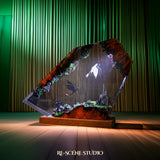
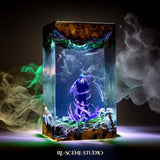
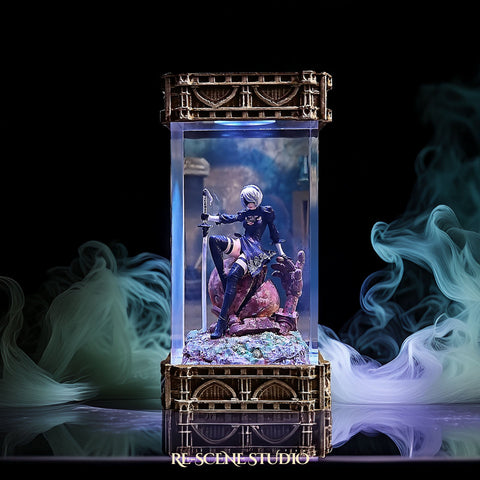
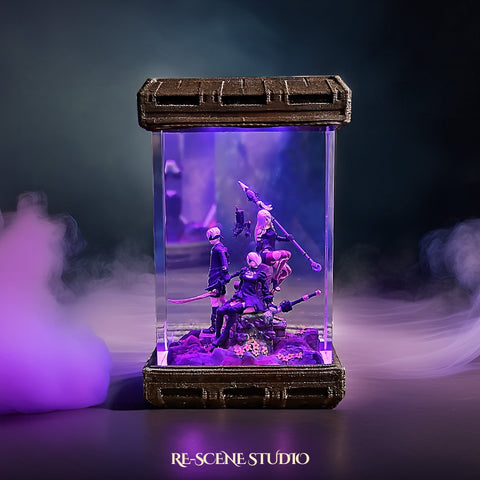
The collection includes multiple Tanjiro pieces capturing different moments. The standalone Tanjiro lamp focuses on him in Water Breathing form; the Tanjiro and Nezuko piece captures the sibling bond that defines the show.

The Tanjiro and Nezuko piece adds the protective sibling visual that captures the show's emotional center:


How Tanjiro Compares to Other Shounen Protagonists
| Protagonist | Show | Core Trait | How Tanjiro Differs |
|---|---|---|---|
| Naruto Uzumaki | Naruto | Loud, persistent, optimistic | Quieter, more reflective |
| Monkey D. Luffy | One Piece | Cheerful, adventure-driven | More serious, family-driven |
| Goku | Dragon Ball | Combat-obsessed, naive | Empathetic, morally engaged |
| Izuku Midoriya (Deku) | My Hero Academia | Determined to be a hero | Forced into role rather than chose it |
| Yuji Itadori | Jujutsu Kaisen | Sacrificial, kind | Similar empathy, different cosmic stakes |
| Sung Jin-Woo | Solo Leveling | Power-fantasy individual | Tanjiro is community-rooted, not solo |
Tanjiro's closest contemporary is probably Yuji Itadori (Jujutsu Kaisen). Both are gentle protagonists in violent shows. Both prioritize the people around them over personal goals. Both pay enormous personal cost for empathy. The Tanjiro/Yuji pairing represents a 2020s shounen trend toward emotional rather than mechanical heroism.
For deeper context on the broader shounen landscape, our JJK cursed energy guide, MHA Final Season lore guide, and Solo Leveling power system guide cover the parallel universes Tanjiro shares the genre with.
Why a Tanjiro Lamp Lands as Decor
Tanjiro pieces work as adult-collector decor for the same reasons the character works as a protagonist: he reads as serious, family-centered, and emotionally weighted rather than juvenile. A Tanjiro resin lamp on a desk doesn't read as childish merch the way a Funko Pop might. It reads as: this person watched a show that earned its emotional weight, and they wanted a piece that captured it.
For broader Demon Slayer context, our existing posts on the complete Breathing Styles guide and the Infinity Castle resin lamp lineup cover the franchise's broader collectible landscape.
Frequently Asked Questions
Featured Resin Lamps
Handcrafted with care, each one unique
Every lamp we create carries a piece of our heart: a small universe of light, resin, and imagination, handcrafted in our workshop for someone across the world who shares our love for these stories.