



Solo Leveling Power System: Hunter Ranks and Gates Explained
The solo leveling ranking system is deceptively simple on the surface. Hunters get ranked from E to S. Gates get classified by the same scale. Higher rank means stronger monster, tougher dungeon, and more powerful hunter. Easy enough, right?
Not quite. Beneath that clean hierarchy lies a system riddled with exceptions, political complications, and power gaps so massive that the difference between an S-Rank hunter and everyone else is less like a ranking tier and more like a different species. And above S-Rank, there are beings that the system was never designed to classify at all.
This guide breaks down the full Solo Leveling power structure. We'll cover every hunter grade, how gates work, what makes National-Level Hunters different from regular S-Ranks, the true nature of the Monarchs and Rulers, and how Sung Jin-woo shattered the entire framework.
The Gate System: E to S Rank
Gates are dimensional rifts that connect the human world to dungeons filled with magical beasts. They appear randomly across the globe, and each gate is classified by rank based on the strength of the monsters inside. If a gate isn't cleared within a set time, it experiences a "dungeon break," releasing all its monsters into the real world. That countdown timer is what makes the hunter profession a necessity rather than a choice.


E-Rank Gates
E-Rank gates contain the weakest monsters. A small team of E-Rank hunters can clear these without serious danger. The beasts inside are roughly equivalent to dangerous animals: threatening to untrained civilians, but manageable for anyone with awakened abilities. These gates are the training ground for new hunters, and the pay reflects the low risk.
D-Rank and C-Rank Gates
D-Rank and C-Rank gates represent the working middle class of dungeon raiding. The monsters are strong enough to kill unprepared hunters, and teams need coordination and basic strategy to survive. Most professional hunters spend their careers at these levels. The income is steady, the danger is real but manageable, and the dungeons produce valuable magic crystals and materials.
B-Rank Gates
B-Rank gates mark the threshold where things get genuinely dangerous. The boss monsters in B-Rank dungeons can kill experienced hunters. Teams need A-Rank or high B-Rank hunters leading them to clear these safely. Casualties happen. The gap between C-Rank and B-Rank isn't gradual; it's a wall.
A-Rank Gates
A-Rank gates require elite hunter teams to clear. The monsters inside are powerful enough to threaten small cities during a dungeon break. National hunter associations treat A-Rank gate appearances as serious emergencies, deploying their best teams immediately. The bosses in A-Rank dungeons can match or exceed individual A-Rank hunters, making teamwork essential.
S-Rank Gates
S-Rank gates are existential threats. The monsters inside are so powerful that only S-Rank hunters have a realistic chance of surviving, let alone clearing the dungeon. When an S-Rank gate appears, entire nations mobilize. Some S-Rank gates have produced monsters that wiped out full raid parties of A-Rank hunters in seconds.
The Jeju Island S-Rank gate is the most infamous example. An ant colony of magical beasts established itself on the island after a failed raid attempt, and the ants bred a mutant queen whose soldiers were individually stronger than most A-Rank hunters. It took a multinational coalition of S-Rank hunters to clear it, and even then, the operation nearly failed.
Hunter Classification
Hunters are humans who "awakened" with supernatural abilities after gates began appearing worldwide. Every awakened individual is tested and assigned a rank from E to S based on their measured magical power. That initial measurement determines their career trajectory, their income potential, and their social standing.
E-Rank Hunters
E-Rank hunters are the bottom of the hierarchy. Their abilities barely exceed normal human capabilities. Many E-Rank hunters earn less than minimum-wage workers because the low-level gates they can clear produce minimal rewards. Some turn to dangerous practices like entering dungeons above their rank as porters, carrying supplies for stronger hunters in exchange for a share of the loot. It's a desperate living, and the mortality rate is grim.
This is where Sung Jin-woo started. The "World's Weakest Hunter" label wasn't a joke; Jin-woo was genuinely the weakest E-Rank hunter in South Korea. He survived by being cautious, staying near the rear of raid parties, and accepting the scraps that stronger hunters didn't want.
Mid-Tier Hunters (D through B)
D through B-Rank hunters form the bulk of the profession. They clear gates appropriate to their level, earn reasonable incomes, and live relatively normal lives between raids. B-Rank hunters command enough respect and income to live comfortably. The further up you go, the greater the respect, the better the guild invitations, and the higher the pay.
A-Rank Hunters
A-Rank hunters are the elite. Every major guild wants them. National associations track their movements. They can solo most dungeons up to A-Rank and serve as the backbone of S-Rank gate raid parties. In many countries, A-Rank hunters are celebrities. Their contracts with guilds can be worth millions.
S-Rank Hunters
S-Rank hunters exist in a category so far above A-Rank that the gap defies the linear ranking system. A single S-Rank hunter can clear dungeons that would require teams of A-Rank hunters. Their combat abilities approach the supernatural even by hunter standards. Nations treat S-Rank hunters as strategic assets on par with nuclear weapons.
The rarity compounds their value. Most countries have fewer than ten S-Rank hunters. Some have none. When an S-Rank gate opens in a country without its own S-Rank hunters, they must negotiate with other nations for assistance. This dynamic turns hunter rankings into geopolitics.
National-Level Hunters
Above ordinary S-Rank sits an unofficial tier: National-Level Hunters. These are S-Rank hunters whose power is so extreme that they can individually influence the outcome of conflicts between nations. The term isn't an official classification. It's a recognition by the global hunter community that certain individuals have surpassed what S-Rank is supposed to mean.
National-Level Hunters include fighters like Thomas Andre (the strongest hunter in the United States), Liu Zhigang (China's top hunter), and Christopher Reed. Each one possesses abilities that go beyond fighting monsters. Their presence or absence can determine whether a country survives an S-Rank dungeon break.
The political implications are enormous. A nation with a National-Level Hunter has a deterrent against both monster incursions and aggression from other nations. A nation without one is vulnerable on both fronts. Solo Leveling uses this dynamic to explore how the hunter system reshapes international relations, turning individual power into geopolitical currency.
What separates a National-Level Hunter from a regular S-Rank? Raw output, partially. But also domain: National-Level Hunters often possess abilities that scale beyond individual combat. Thomas Andre's Reinforcement lets him shrug off attacks that would kill other S-Ranks. His power isn't just greater; it's categorically different.
The Monarchs and Rulers
Behind the gates, behind the dungeons, and behind the entire awakened system lies a cosmic war that predates human civilization. The Monarchs and Rulers are the true powers in Solo Leveling's universe, and understanding them reframes everything about the ranking system.
The Rulers
The Rulers are beings of light who serve the Absolute Being (the creator deity of Solo Leveling's cosmology). They fought against the Monarchs in an ancient war that nearly destroyed both sides. When the war reached a stalemate, the Rulers devised the system of gates and awakened hunters as a way to strengthen humanity, preparing the human world for the Monarchs' eventual invasion.
Every awakened hunter's power ultimately derives from the Rulers' influence. The ranking system, the awakening process, the gates themselves: all of it is infrastructure built by the Rulers to create soldiers for a war that most humans don't even know is happening.
The Monarchs
The Monarchs are the destruction side of the equation. Each Monarch commands a specific type of magical beast and possesses power that dwarfs anything in the hunter ranking system. The Ant King, the Ice Monarch, the Beast Monarch: each one is a force of nature capable of leveling cities. They created the dungeons as staging grounds for their army's invasion of the human world.
The most important Monarch for the story is the Shadow Monarch, Ashborn. Originally the strongest soldier of the Rulers, Ashborn was betrayed and eventually chose to side with neither faction. His power, the ability to extract shadows from the dead and command an infinite army of shadow soldiers, is the ability that Sung Jin-woo inherits. This inheritance is what makes Jin-woo's progression possible and what ultimately puts him beyond any rank the human system can assign.
Jin-woo's Progression: From E-Rank to Beyond
Sung Jin-woo's journey is the emotional engine of Solo Leveling, and it only works because the ranking system is so rigid for everyone else. Every other hunter is locked into the rank they receive at awakening. They can refine their skills, learn better tactics, and optimize their abilities, but their raw power level doesn't change. An E-Rank hunter will always be an E-Rank hunter.

Jin-woo broke that rule. After the Double Dungeon incident, he gained the System: a game-like interface that allowed him to level up by completing quests, defeating enemies, and training. This mechanic turned his fixed E-Rank potential into an infinitely scaling growth curve.
His progression went something like this. He started at E-Rank, barely able to survive low-level dungeons. Within weeks of receiving the System, he was soloing C-Rank dungeons. Within months, he was clearing dungeons that gave A-Rank hunters trouble. By the Jeju Island raid, he was fighting at S-Rank level. And by the time he inherited the Shadow Monarch's full power, the ranking system simply didn't apply anymore.
The key moment is the Jeju Island ant raid. Jin-woo arrived after the main raid party was being decimated by the Ant King, Beru. He fought Beru solo, defeated him, and then raised him as a shadow soldier. That fight proved to the world that Jin-woo wasn't just another S-Rank hunter. He was something the system had no classification for.
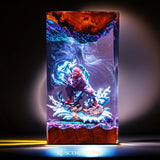
The Shadow Monarch Sung Jin-woo Resin Lamp from Rescene Studio captures Jin-woo at the peak of his transformation. The dark resin work and LED backlighting create the shadow-wreathed atmosphere that defines his most powerful moments. It's a piece that hits differently when you remember he started as the weakest hunter alive.
PRODUCT_HANDLE: shadow-monarch-sung-jin-woo-resin-lamp-solo-leveling
Why Solo Leveling's Power System Works
The solo leveling ranking system succeeds because it takes a simple idea (letter grades for power) and layered complications on top of it until the system itself becomes part of the story. The ranking system isn't just a framework for measuring power. It's a social structure with all the unfairness, politics, and blind spots that real social structures contain.
E-Rank hunters are exploited. S-Rank hunters are worshipped and feared. National-Level Hunters become geopolitical chess pieces. And above it all, the Monarchs and Rulers fight a war that makes the entire human ranking system look like children sorting themselves by height.
Jin-woo's growth is compelling because it breaks a system that everyone else is trapped in. He's not just getting stronger; he's transcending a framework that defines everyone's place in the world. That's a fantasy that resonates far beyond anime fans, and it's why Solo Leveling's power system has captured such a massive global audience.
Explore the full Solo Leveling collection at Rescene Studio for handcrafted resin lamps that bring the shadow army to life on your desk.
Frequently Asked Questions
Featured Resin Lamps
Handcrafted with care, each one unique
Every lamp we create carries a piece of our heart: a small universe of light, resin, and imagination, handcrafted in our workshop for someone across the world who shares our love for these stories.