





Desk Decor Ideas That Actually Make You More Productive

Most desk decor advice falls into two camps. The minimalists say clear everything off your desk except a laptop and a glass of water. The maximalists want you buried in plants, crystals, motivational quotes, and a dozen fidget toys. Neither approach actually helps you get more done.
Research from Princeton's Neuroscience Institute found that visual clutter competes for your attention, reducing working memory and increasing cortisol. But a completely bare desk triggers a different problem: sensory deprivation that makes your brain seek stimulation elsewhere (hello, phone scrolling). The productive middle ground is intentional decor: items that serve a function, regulate your mood, or reward sustained focus.
Here are desk decor ideas backed by what actually works for concentration and output, not just what looks good on Instagram.
The Science of Desk Environment
Before buying anything, understand what your brain needs from a workspace. Three environmental factors consistently predict focus quality in workplace research:
| Factor | Optimal Range | Effect on Productivity |
|---|---|---|
| Lighting | 300 to 500 lux at desk surface | +15% task accuracy (Journal of Environmental Psychology, 2023) |
| Temperature | 22 to 25°C (72 to 77°F) | Typing errors increase 44% below 20°C (Cornell study) |
| Visual complexity | Moderate (3 to 7 objects in view) | Too few = boredom, too many = distraction (Princeton study) |
The takeaway: your desk needs enough visual interest to keep your brain engaged, good lighting to reduce eye strain, and nothing that actively pulls attention away from work. Every decor choice should serve one of these three needs.
Tier 1: Functional Decor (Things That Help You Work)
Task Lighting That Matches Your Work
If you only improve one thing about your desk setup, make it the lighting. A dedicated task lamp aimed at your work surface reduces eye strain by up to 60% compared to relying on overhead room lighting alone. The key spec is adjustable color temperature: 4000K to 5000K (neutral to cool white) for focused work like reading and coding, 2700K to 3000K (warm white) for creative work and video calls.
Budget options: IKEA's Tertial ($10) or any adjustable arm lamp with an LED bulb. Mid-range: BenQ ScreenBar ($109) clips to your monitor and eliminates screen glare with zero desk footprint. Premium: Dyson Lightcycle ($550) auto-adjusts color temperature based on time of day and your age. Any of these will transform your desk experience more than any decorative item. The important thing isn't the brand; it's the adjustability. A lamp locked at one brightness and color temperature is half a tool.
A Single Plant (Not a Jungle)
A 2014 study from the University of Exeter found that workers with one plant visible from their desk were 15% more productive than those in bare environments. The catch: more plants didn't increase the effect. One plant signals "this space is cared for." Ten plants signals "this space is a greenhouse."
For desks, choose something that tolerates low light and irregular watering. Pothos, snake plants, and ZZ plants survive neglect. Succulents look great on Instagram but actually need direct sunlight, which most desk positions don't get. If your desk is far from a window, skip the succulent and go with a pothos in a small ceramic pot.

Tier 2: Mood Regulators (Things That Keep You Going)
Ambient Accent Lighting
Overhead lights wash everything in flat, even brightness. Adding a single accent light source creates depth and visual warmth that makes your desk feel like a place you want to sit, not a place you have to sit. This is the difference between a desk that feels like a cubicle and one that feels like your space.
LED strips behind your monitor ($10 to $20) reduce eye strain by eliminating the harsh contrast between a bright screen and a dark wall. A small accent lamp on the non-dominant side of your desk ($20 to $80) adds warm atmosphere without competing with your task light. The trick is keeping accent lights at a lower brightness than your task light so they provide ambiance without distraction.
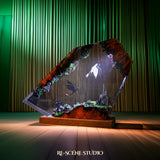
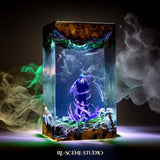
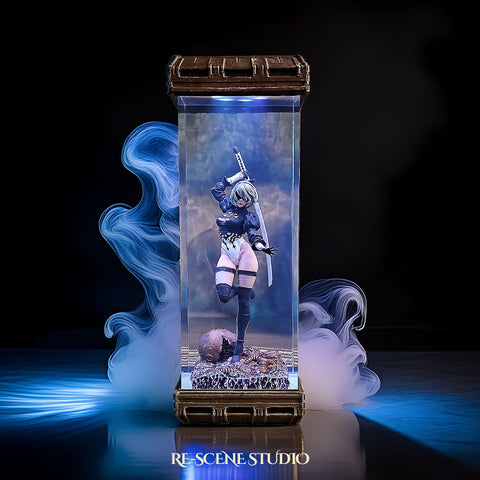
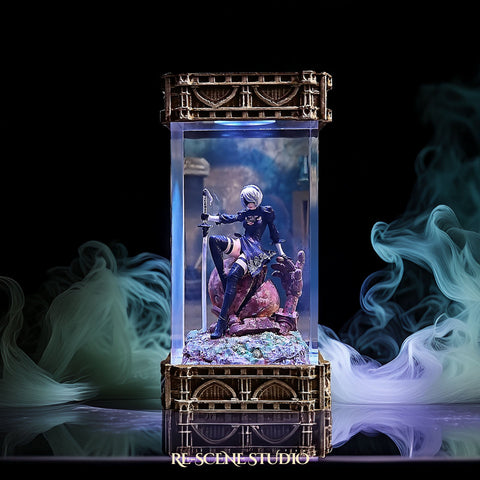
For something that doubles as both ambient lighting and a conversation piece, handcrafted art lamps embed LED lighting inside detailed resin sculptures. They're functional (they provide actual light) and decorative (they give your eye something interesting to rest on during focus breaks). The warm glow from embedded LEDs is particularly effective for late-night work sessions when harsh overhead lights feel aggressive. For more ideas on ambient lighting, check out our guide on how desk lighting transforms your workspace.

A Focus Reward Object
This is a concept from behavioral psychology: place a small, visually interesting object on your desk that you only allow yourself to look at or pick up during planned breaks. It creates a micro-reward loop that reinforces sustained focus. The object itself matters less than the ritual. A smooth stone, a small figure, a mechanical puzzle: anything that's satisfying to hold for 30 seconds before returning to work.
Collectors often use their favorite desk figure or art piece for this purpose. The key is keeping it to one item. If your desk has 15 figures, none of them function as a reward.
Some workers use the Pomodoro Technique (25 minutes of work, 5-minute break) with their focus reward object. During work intervals, the object is off-limits. During breaks, they pick it up, examine it, or simply enjoy looking at it. Over time, the brain associates the object with the pleasant feeling of earned rest, strengthening the focus-reward loop.
Tier 3: Identity Pieces (Things That Make It Yours)
The One Statement Piece
Every productive desk benefits from one item that says "this is my space." For some people, that's a framed photo. For others, it's an art print, a model kit, or a collectible that reflects a hobby or passion. The psychological effect is ownership: a personalized space triggers a sense of control that correlates with higher job satisfaction and output.
The rule is one statement piece, not five. Pick the thing you're most proud of or that makes you happiest to look at, and give it a prominent position. Everything else is supporting cast.
If you're into gaming or anime, a themed art lamp can serve double duty as both your statement piece and your accent light source, killing two birds with one stone. For readers who also want to personalize their room beyond the desk, our guide on displaying anime collections as an adult covers how to make personal decor look intentional rather than cluttered.

What to Remove from Your Desk
Productive desk decor is as much about what you take away as what you add. These items consistently hurt focus in workspace studies:
- Your phone. Even a face-down phone reduces cognitive capacity by 10% (University of Texas, 2017). Put it in a drawer.
- Paper piles. Unfinished tasks in your visual field create low-grade anxiety. File or digitize everything weekly.
- Multiple monitors you don't use. A second screen is productive only if you actively use it. An unused screen is visual noise.
- Motivational quotes. Your brain stops reading them after 3 days. They become wallpaper, not motivation.

The Productive Desk Checklist
- Task lamp with adjustable color temperature ($10 to $109)
- One plant that tolerates your lighting conditions ($5 to $15)
- Accent light source for atmosphere: LED strip or art lamp ($10 to $89)
- One statement piece that reflects your personality
- Nothing else visible that doesn't serve work or well-being
Frequently Asked Questions
Featured Resin Lamps
Handcrafted with care, each one unique

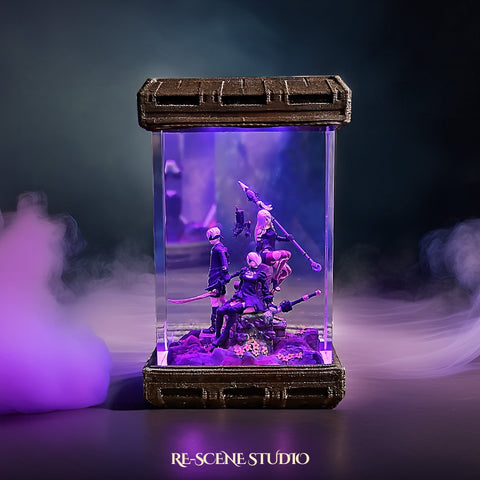
Every lamp we create carries a piece of our heart: a small universe of light, resin, and imagination, handcrafted in our workshop for someone across the world who shares our love for these stories.