


![[FATHER'S DAY] Ember Glow Ticket | $6.68 — Handcrafted Epoxy Resin LED Lamp | Unique Ambient Decor & Collector's Gift](http://rescenestudio.com/cdn/shop/files/Lucky_Star_Ticket_NYE_2026_c61361fc-ea06-4a31-8379-e16ed7d47902.jpg?v=1767177179&width=320)


Black Myth Wukong Lore: The Monkey King Legend Explained

Black Myth Wukong lore goes far deeper than most players realize. The game didn't invent its mythology. It borrowed from Journey to the West, a 16th-century Chinese novel that has shaped storytelling across Asia for centuries. Understanding that source material changes how you interpret every boss encounter, every environment, and every cryptic piece of dialogue in the game.
Most Western players picked up Black Myth Wukong for the combat. Tight soulslike action, stunning environments, and some of the best boss design in recent years. But the story left many players confused, because it assumes you already know who Sun Wukong is, what he did, and why the events of the game matter. This guide fills in those gaps.
Who Is Sun Wukong? The Original Monkey King
Sun Wukong was born from a magical stone on the Mountain of Flowers and Fruit, imbued with the essence of heaven and earth. He emerged as a fully formed monkey, joined a colony of primates, and quickly rose to become their king by proving his courage. But kingship wasn't enough. Wukong wanted immortality.
He trained under the immortal Master Subodhi, learning the 72 Transformations (the ability to shapeshift into almost anything) and the cloud-somersault technique that could carry him 108,000 li (roughly 54,000 kilometers) in a single leap. He also acquired his signature weapon, the Ruyi Jingu Bang, a magical iron staff weighing roughly 17,500 pounds that could grow or shrink at will. It originally served as a pillar holding up the Dragon King's underwater palace, and Wukong was the only being strong enough to wield it.
Armed with god-level power and an ego to match, Wukong crashed the Heavenly Court, ate the Peaches of Immortality reserved for the gods, consumed Laozi's pills of longevity (making himself essentially indestructible), and defeated an army of 100,000 celestial soldiers. It took the Buddha himself to stop him, trapping Wukong under a mountain for 500 years.

The Journey to the West: Redemption Through Service
After 500 years under the mountain, Wukong was offered a deal: escort the Buddhist monk Tang Sanzang on a pilgrimage to retrieve sacred scriptures from India, and earn his freedom plus a path to enlightenment. Wukong agreed, but not without resistance. To keep him in check, the monk placed a golden headband on Wukong that tightened painfully whenever the monk chanted a specific sutra.
The journey was anything but peaceful. Along with two other reformed sinners (Zhu Bajie, a pig demon driven by gluttony and lust, and Sha Wujing, a river demon seeking atonement), the Monkey King battled 81 trials across treacherous landscapes filled with demons, spirits, and divine tests. Each trial tested not just combat skill but character: patience, humility, compassion, and the willingness to protect someone physically weaker than yourself, even when that person frustrates you.
The novel's 100 chapters follow this episodic structure, and it's these chapters that provide the boss encounters, environments, and narrative threads in Black Myth Wukong. The Yaoguai (demons) you fight in the game aren't random monsters. Many are direct references to specific demons from the novel, each with their own backstory, motivations, and connection to Wukong's original journey.
How the Black Myth Wukong Lore Reimagines the Legend
The game doesn't retell Journey to the West. It takes place after the novel's conclusion. In the original story, Wukong achieves Buddhahood as a reward for completing the pilgrimage. But Black Myth Wukong asks a provocative question: what if Wukong rejected that reward?
In the game's version, Wukong returns to Mount Huaguo to live among his monkeys, rejecting the Celestial Court's hierarchy. The Court, distrustful of an uncontrollable being with god-level power, sends Erlang Shen (a powerful war god and Wukong's historical rival) to force his submission. Wukong fights, but the golden headband still binds him, and he's sealed in stone once again.
You play as the Destined One, a monkey warrior who must recover six relics corresponding to Wukong's six senses. Each relic is guarded by powerful Yaoguai, and each boss fight peels back another layer of what happened to the Monkey King and why. The journal pages you unlock through defeating bosses contain details pulled directly from the original novel, recontextualized for the game's alternate timeline.
This narrative structure is what separates it from a standard action RPG. The combat is the delivery mechanism for mythology. Every boss has a history, a grievance, and a connection to the original pilgrimage. Players who know the source material catch references that fly past everyone else, from the specific demons that appear in each chapter to the symbolic meaning of the environments themselves.
The Companions and Rivals You Should Know
Wukong didn't journey alone. Understanding his companions and rivals adds depth to many encounters in the game.
Zhu Bajie (Pigsy): A former Marshal of the Heavenly Navy, Bajie was cast down for drunkenly flirting with the Moon Goddess. He was reborn as a pig demon, combining enormous physical strength with an insatiable appetite for food, drink, and women. Despite his flaws, Bajie is surprisingly effective in combat and often serves as comic relief. His presence in the game references specific chapters where his laziness or gluttony created problems the Monkey King had to solve.
Sha Wujing (Sandy): Once a celestial curtain-lifting general, he was banished for accidentally breaking a crystal goblet. He became a river demon, living in guilt and solitude for years until joining the pilgrimage as the group's most loyal and humble member. He rarely speaks in the novel but never wavers in his commitment to the mission.
Erlang Shen: The three-eyed war god and Wukong's most dangerous rival. In the original novel, Erlang was one of the few beings who could match Wukong blow for blow in combat. Their shape-shifting battle is one of the most celebrated sequences in Chinese literary history, with both warriors cycling through dozens of animal and elemental forms trying to outwit each other.

Why This Story Still Resonates 500 Years Later
Journey to the West endures because Wukong's arc is universally relatable. He starts as pure ego: powerful, reckless, answering to nobody. His imprisonment forces reflection. The journey teaches him that raw strength without wisdom is destructive, and that true power comes from discipline and service to something greater than yourself.
But there's a subversive edge that keeps the story from feeling preachy. Wukong never fully submits. He protects the monk, fights the demons, and earns his redemption, but he does it with irreverence, humor, and a refusal to bow to authority he considers corrupt. He's not a saint. He's a trickster who learned just enough restraint to channel his chaos into something useful.
That tension between rebellion and discipline is exactly what Black Myth Wukong captures in its gameplay. You wield overwhelming power, but every boss fight demands precision, patience, and tactical restraint. Button-mashing gets you killed. Reading patterns, waiting for openings, and choosing your transformations carefully is how you win. It's the journey's lesson, expressed through combat design.
If you enjoy games that weave deep mythology into their mechanics, our guides for Dark Souls and Bloodborne explore similar themes of cyclical suffering and hard-won understanding.
The Cultural Impact Beyond Gaming
The Monkey King's influence stretches far beyond any single medium. He's appeared in over 100 films, dozens of TV series, manga, anime (Dragon Ball's Goku is directly inspired by Sun Wukong), and now one of the best-selling games of the 2020s. In East Asian pop culture, he occupies a role similar to Thor or Hercules in Western storytelling: a mythological figure who keeps getting reinterpreted for each generation.
What makes the game's version special is its willingness to question the original ending. In the novel, Wukong's submission to Buddhist hierarchy is presented as spiritual growth. The game reframes it as potentially unjust: why should the most powerful being in existence be forced to serve a system that fears him? It's a modern reading of an ancient text, and it resonates with players who've felt the tension between individual freedom and institutional expectation. This depth of mythology is what elevates the game beyond spectacle into genuine storytelling.
Bringing the Legend to Your Desk
For fans who want a physical connection to the mythology beyond the screen, Rescene Studio offers two handcrafted Wukong pieces that capture different aspects of the Monkey King's story.
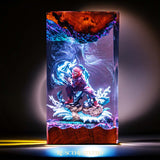
The Wukong Resin Lamp 1 captures the Monkey King in a moment of focused power, with warm LED light illuminating the handcrafted resin scene. Each piece is unique because the resin curing process creates slightly different patterns and light effects every time.

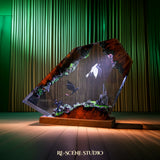
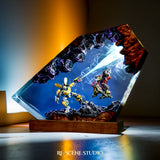
The Wukong Resin Lamp 2 presents a different scene from the legend, offering a complementary piece for collectors who want both interpretations side by side on their desk or gaming setup.

| Feature | Wukong Lamp 1 | Wukong Lamp 2 |
|---|---|---|
| Price | From $59 | From $59 |
| Style | Focused power stance | Dynamic action scene |
| LED Color | Warm amber | Warm amber |
| Best For | Desk or nightstand display | Gaming setup centerpiece |
| Material | Handcrafted resin | Handcrafted resin |
Frequently Asked Questions
Featured Resin Lamps
Handcrafted with care — each one unique


Every lamp we create carries a piece of our heart — a small universe of light, resin, and imagination, handcrafted in our workshop for someone across the world who shares our love for these stories.