





![[FATHER'S DAY] Ember Glow Ticket | $6.68 — Handcrafted Epoxy Resin LED Lamp | Unique Ambient Decor & Collector's Gift](http://rescenestudio.com/cdn/shop/files/Lucky_Star_Ticket_NYE_2026_c61361fc-ea06-4a31-8379-e16ed7d47902.jpg?v=1767177179&width=320)


The Psychology of Collecting: Why We Can't Stop

You told yourself you'd buy one. Just one figure, one card, one piece of art for the shelf. Now you own twelve, and you're browsing for number thirteen while telling yourself this is absolutely the last one. Sound familiar? You're not weak-willed. You're experiencing a well-documented neurological reward loop that affects roughly one in three adults, according to a 2022 study published in the Journal of Consumer Psychology.
Collecting is one of the oldest human behaviors, crossing every culture and era in recorded history. Archaeologists have found curated shell collections in caves dating back 100,000 years. The drive to gather, organize, and display meaningful objects is hardwired into human cognition at a fundamental level, and understanding exactly why your brain does this can help you enjoy collecting without letting it control your wallet or your living space.
The Dopamine Loop: Why Finding "The One" Feels So Good
When you spot a collectible you've been searching for, your brain releases dopamine, the same neurotransmitter triggered by food, social connection, and yes, addictive substances. But here's the nuance that most pop-science articles miss: dopamine isn't actually the "pleasure chemical." It's the anticipation chemical. Your brain releases the most dopamine during the search and discovery phase, not when you actually own the item.
This explains a pattern every collector recognizes: the thrill of finding something is more intense than the satisfaction of having it. A week after the purchase, the item sits on your shelf and feels normal. Your brain is already scanning for the next hit. This isn't a flaw in your character. It's your nucleus accumbens doing exactly what evolution designed it to do: motivate you to keep seeking.

The Endowment Effect: Why Selling Feels Like Loss
Nobel Prize-winning economist Richard Thaler documented a cognitive bias called the endowment effect: people value things they own more than identical things they don't own. In experiments, people demanded roughly twice as much to sell a coffee mug they'd been given as they'd pay to buy the same mug. For collectors, this effect is amplified by emotional attachment and narrative (the story of how you found each piece).
This is why downsizing a collection feels painful even when you logically know you have too much. Each item carries a memory of the hunt, the discovery, the moment of acquisition. Selling it doesn't just reduce your shelf space. It erases a chapter of a story you've been writing about yourself.
The Completion Drive: Sets, Series, and the Zeigarnik Effect
Russian psychologist Bluma Zeigarnik discovered in 1927 that people remember incomplete tasks better than completed ones. Your brain treats an incomplete collection as an open loop that demands closure. This is why owning 7 of 8 figures in a series feels significantly worse than owning only 3 of 8. The closer you are to completion, the stronger the urge to finish.
Manufacturers know this. Limited edition series, numbered prints, seasonal variants: these are designed to create open loops. "You have the spring and summer versions? The autumn edition just dropped." Your brain can't help but calculate how close you are to the complete set, and that gap between 3/4 and 4/4 generates disproportionate motivation.

Identity and Self-Expression
Collections serve as external representations of internal identity. A shelf of anime figures tells visitors "I'm a fan of Japanese culture." A wall of vinyl records says "music matters to me." A desk with handcrafted art pieces communicates taste, patience, and an appreciation for craftsmanship. Research from the University of Michigan found that people with curated personal displays report higher self-esteem than those with generic or bare living spaces.
This identity function explains why collectors are often protective of their collections beyond monetary value. An insult to someone's collection feels like an insult to their identity. Conversely, a compliment on a collection ("where did you find that?") triggers genuine pride because it validates a part of who they are.
For collectors who also value unique, conversation-starting pieces, handcrafted art lamps serve double duty. They're both a collectible (each one is unique) and functional (they provide ambient lighting). The intersection of utility and uniqueness is what makes certain collectibles feel justified rather than indulgent. For ideas on displaying collections tastefully, see our guide on how adults display collections without looking childish.
The Social Dimension: Collecting as Community
Collecting is rarely a solo activity, even when it looks like one. Most collectors actively participate in communities: subreddits, Discord servers, conventions, local meetups, or simply showing their shelves to friends who visit. A 2023 survey by the Hobby Industry Association found that 68% of active collectors consider their hobby "social," naming online community participation as a primary source of enjoyment alongside the items themselves.
The social component adds another reward layer beyond the dopamine of acquisition. Sharing a rare find with people who understand its significance triggers belonging and validation. When someone in a Pokemon card community says "no way, you found a PSA 10 Base Set Charizard?" the emotional payoff rivals the find itself. This communal knowledge and shared excitement is something that generic shopping can't replicate.
For many adult collectors, the community also provides permission. In a culture that sometimes dismisses adult collecting as immature, finding a group of fellow enthusiasts normalizes the hobby and removes the self-consciousness that might otherwise limit it. The collector who feels embarrassed showing their shelf to coworkers feels completely at home posting it on a dedicated subreddit with 200,000 members.
When Collecting Becomes a Problem
Healthy collecting adds joy, identity, and structure to life. Unhealthy collecting creates financial stress, relationship tension, or living space that's more storage unit than home. The line between the two isn't about quantity. It's about control.
Red flags include: buying to manage anxiety rather than for genuine excitement; hiding purchases from partners; going into debt for items; feeling unable to stop even when the joy has faded; and physical clutter that affects daily functioning. If three or more of these apply, the behavior may have crossed from hobby into compulsion, and speaking with a therapist who specializes in behavioral patterns is worth considering.
For most collectors, simple guardrails prevent problems. A monthly budget cap ($50 to $100 is common). A "one in, one out" rule for shelf space. A 48-hour waiting period before purchases over $100. These aren't restrictions on joy. They're frameworks that keep the hobby sustainable and enjoyable for years rather than months.
The healthiest collectors also practice periodic curation: every 6 to 12 months, they review their collection and ask "does this still bring me joy?" Items that no longer resonate can be sold, gifted, or donated, making room for pieces that better reflect who you are now versus who you were when you bought them. Collections should evolve with you, not anchor you to past impulses.
| Healthy Collecting | Warning Signs |
|---|---|
| Brings genuine joy and pride | Buying to relieve anxiety or boredom |
| Fits within a set budget | Going into debt for items |
| Curated, intentional choices | Buying everything available without selectivity |
| Comfortable showing/discussing it | Hiding purchases from partner or family |
| Enhances living space | Clutters living space, causes daily friction |


Frequently Asked Questions
Featured Resin Lamps
Handcrafted with care — each one unique


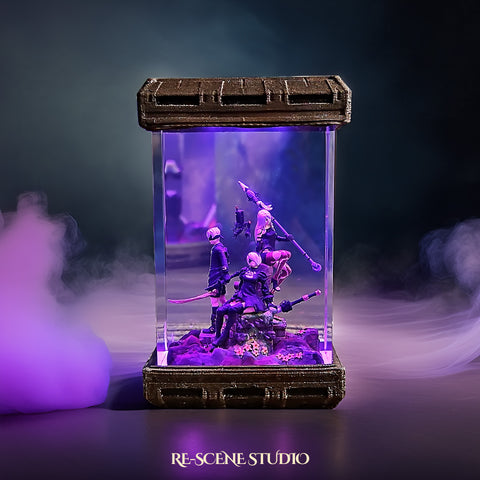
Every lamp we create carries a piece of our heart — a small universe of light, resin, and imagination, handcrafted in our workshop for someone across the world who shares our love for these stories.