




Solo Leveling Hunter Ranks Explained: E to National Level

In Solo Leveling, the rank system runs from E-Class (the weakest) to National Level Hunter (the strongest). Six tiers, with each rank classified by an official Hunter Association evaluation that measures mana capacity, combat ability, and physical attributes. The system is the spine of the show's economy: hunters get paid based on rank, dungeon raids assemble around rank balance, and the entire global power structure tracks who sits at S-Class or above. Understanding the ranks is understanding the show.
This guide walks through every rank in order, explains what each can actually do, and covers the National Level Hunter exception that defines the late-game power scaling. By the end you'll know exactly what "S-Rank" means, why E-Class is treated as cannon fodder, and why Sung Jin-Woo's eventual position breaks the entire system.
How the Hunter Rank System Actually Works
The Hunter Association measures every awakened individual through a standardized test. The measurement combines mana reserves, combat skill demonstrations, and physical conditioning. The test produces a numerical score that maps to a rank: E, D, C, B, A, S, and then the special National Level designation above S.
Two important details most readers miss. First, ranks can change. A hunter who trains and grows stronger can be re-evaluated and promoted. The system isn't static. Second, the measurement focuses on raw capability, not strategic skill. A C-Rank with brilliant tactics can outperform a B-Rank with raw power but poor decision-making, even though the B-Rank gets paid more.
The economic implications matter for the world-building. E-Class hunters take low-pay raids in safe dungeons. S-Class hunters command tens of millions per raid and have their own teams. National Level Hunters are essentially state assets, with global political and military implications.
| Rank | What They Can Handle | Typical Income | Population |
|---|---|---|---|
| E-Class | F-Rank dungeons (cleanup work) | Subsistence wages | Most common |
| D-Class | E and D Gates, mid-tier dungeons | Working class | Common |
| C-Class | C-Rank dungeons, bandit hunting | Solid middle | Less common |
| B-Class | B-Rank, dangerous mid-tier | Upper middle | Skilled minority |
| A-Class | A-Rank dungeons, magic-tier monsters | Wealthy | Rare elite |
| S-Class | S-Rank dungeons, raid leaders | Multimillionaires | Very rare |
| National Level | Civilization-tier threats | State-level | Single digits globally |

E-Class: The Bottom Tier and Its Brutal Economics
E-Class is where most awakened individuals start and where many stay. They have just barely enough mana to qualify as hunters, and their combat abilities are limited to weak monsters and cleanup tasks in already-cleared dungeons. Sung Jin-Woo starts here, classified as the "Weakest Hunter of All Mankind" , a designation that's both technically accurate and emotionally crushing.
The economics for E-Class are brutal. They take whatever raids are available, often in dangerous low-tier dungeons because higher-rank hunters refuse the work. They earn just enough to survive. Hospital bills from injuries quickly bankrupt them. The "weakest hunter" label isn't just a power statement , it's an economic sentence.
This setup is what makes the show's central twist hit so hard. The Double Dungeon incident that gives Jin-Woo his player system happens because E-Class hunters are expendable enough to be sent into a dungeon that other hunters refused.
D-Class to C-Class: The Working-Class Hunters
D and C-Class are where most professional hunters live. They have stable careers, can afford rent and basic comforts, and form the backbone of the Hunter Association's daily raid economy. Most hunting guilds are mostly C-Class with a few B-Class team leaders.
The combat abilities at this tier are competent but not extraordinary. C-Class hunters can clear standard dungeons solo or in small teams, handle most goblin and orc-tier monsters, and survive moderately dangerous raids. They're the show's "regular soldiers" , vital to the system but rarely heroes of the story.
The transition from D to C is one of the most significant in a hunter's career. C-Class is where stable income begins, where hunters can afford their own equipment, and where guild recruiters start paying attention.
B-Class to A-Class: Where Power Becomes Visible
B-Class is where hunters become recognizable. Strong enough to handle dangerous magic-using monsters, lead small raids, and contribute meaningfully to A-Rank gate clears as part of larger teams. B-Rank hunters are skilled and respected but still fundamentally team players.
A-Class is the elite tier below S-Class. A-Rank hunters can solo dangerous raids, lead major operations, and command significant respect. They earn what amounts to hedge-fund money in real-world terms. Most major hunting guilds have one or two A-Class hunters as senior leadership and dozens of B-Class as their primary force.
For more anime power-system breakdowns that follow similar progression logic, our Jujutsu Kaisen cursed energy guide covers a comparable hierarchy in JJK's Grade system, and our Naruto power-ups breakdown tracks how shounen typically structures escalation.

S-Class: The Top of the Conventional System
S-Class hunters are the strongest officially recognized tier (excluding the special National Level designation above). At S-Class, a single hunter can clear most A-Rank gates solo, take down boss monsters that would require entire raid teams of B-Rank hunters, and command political and economic power equal to small corporations.
The number of S-Class hunters globally is small , typically 20 to 30 across the entire world at any given time. South Korea, where the story is set, has around five S-Class hunters before Jin-Woo's awakening. Each one is essentially a national asset.
What separates S-Class from A-Class isn't just raw power; it's adaptability. S-Class hunters can handle situations they haven't trained for, improvise tactics on the fly, and lead in true high-stakes scenarios. They are the people called when a B-Rank gate suddenly upgrades mid-raid or when an unknown S-Rank threat appears.

National Level Hunters: The Above-S Designation
National Level Hunter is not a rank in the traditional sense. It's a special designation given to hunters whose raw power exceeds standard S-Class measurements to a degree that they pose a national security implication. There are typically only 5-7 National Level Hunters globally at any time , these include figures like Liu Zhigang of China, Christopher Reed of the United States, Thomas Andre of the United States, and Goto Ryuji of Japan.
National Level Hunters operate outside normal guild structures. They're treated as state assets and frequently coordinate directly with government agencies on threat-tier dungeon clears that exceed the capacity of any normal team.
Sung Jin-Woo eventually surpasses even this tier. The Shadow Monarch's power is so far beyond National Level that the existing measurement system breaks. The story's fascination with this , how do you classify someone who is functionally a god-tier being using a hunter rank system designed for measuring mortal awakened individuals? , is part of what makes the late arcs so compelling.

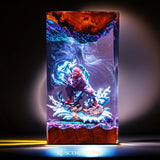
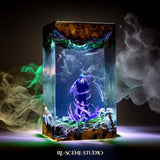
For more on the Shadow Monarch transformation and the lamp collection that captures Jin-Woo's evolution across the series, our Solo Leveling Shadow Monarch collection guide walks through every variant.
Why the Rank System Matters for the Story
Solo Leveling's rank system is more than just a power scale. It's a narrative device that lets the show measure progress with mathematical clarity. When Jin-Woo gets re-evaluated and jumps multiple ranks, the audience knows exactly how much stronger he is. When he meets a new opponent, their rank tells you the stakes.
The system also creates dramatic irony. Other characters consistently underestimate Jin-Woo because his official rank lags behind his actual power. The reader knows he's stronger than the rank suggests; the in-world characters don't. Every time someone treats Jin-Woo as "just an E-Class," the audience experiences a moment of dramatic tension that the rank system enables.
Compare this to power systems in other modern shounen, where vague hierarchies (Hunter x Hunter's Nen, JJK's Cursed Energy intensity) leave more room for interpretation. Solo Leveling's clear numerical system is one of the reasons the series translated so well to international audiences. It removes ambiguity.
Real-World Parallels: How the Hunter System Maps to Other Hierarchies
Solo Leveling readers often note that the Hunter rank system feels grounded in a way that pure-magic systems don't. The reason: the system mirrors real-world expert hierarchies. Three useful comparisons:
Military rank. The progression from E-Class soldier to National Level Hunter parallels the progression from Private to General. Each rank has a defined scope of responsibility and a measurable performance bar. The S-Class to National Level jump is similar to the General to head-of-state distinction: the difference becomes political and strategic rather than just operational.
Professional sports tiers. E-Class hunters are amateur leagues, C-Class are minor leagues, A-Class are major leagues, S-Class are championship-level players, and National Level Hunters are the once-a-decade superstars whose names define their era. The economic structure (low pay at the bottom, hedge-fund money at the top) follows the same exponential curve.
Surgical specialization. A general E-Class hunter is like a general practitioner. A specialized A-Class is like a board-certified surgeon. An S-Class is the fellowship-trained subspecialist. The escalating expertise required at each tier maps cleanly onto medical training pipelines.
Understanding these parallels makes the rank system feel less like arbitrary anime power-scaling and more like a serious thought experiment about how a society would structure expertise around magical ability. That grounded quality is part of why Solo Leveling crossed over to non-anime audiences who normally avoid the genre.
Frequently Asked Questions
Featured Resin Lamps
Handcrafted with care, each one unique
Every lamp we create carries a piece of our heart: a small universe of light, resin, and imagination, handcrafted in our workshop for someone across the world who shares our love for these stories.