


![[FATHER'S DAY] Ember Glow Ticket | $6.68 — Handcrafted Epoxy Resin LED Lamp | Unique Ambient Decor & Collector's Gift](http://rescenestudio.com/cdn/shop/files/Lucky_Star_Ticket_NYE_2026_c61361fc-ea06-4a31-8379-e16ed7d47902.jpg?v=1767177179&width=320)


Persona 5: Why Joker Is Gaming's Coolest Protagonist

Most video game protagonists talk too much, say too little, and look like they were designed by committee. Then there's Joker from Persona 5: a quiet transfer student by day, a masked phantom thief by night, and somehow the coolest character in a game full of unforgettable personalities. He barely speaks. He doesn't need to.
Since Persona 5's original release in 2016 (and its expanded version Persona 5 Royal in 2020), Joker has become one of gaming's most recognizable characters. He joined Super Smash Bros. Ultimate, starred in the anime adaptation, appeared in multiple crossover games, and became the benchmark that every JRPG protagonist is now measured against. Here's why he works so well, and what his design tells us about great character creation.
The Silent Protagonist, Done Right
Silent protagonists are a JRPG tradition that usually feels like a limitation. The player character doesn't talk because the player is supposed to project themselves onto the blank slate. In practice, this often makes the hero feel hollow. Link works because Zelda games are about exploration. Cloud works because the story speaks for him. Most other silent protagonists are forgettable.
Joker breaks this pattern. Despite rarely speaking, he communicates constantly through body language, style, and context. His animations during battles, the way he adjusts his gloves before a fight, the casual lean against walls during conversations, and his iconic mask-removal animation all convey personality without a single word. Atlus designers described his visual concept as a "black panther": sleek, confident, dangerous, and always in control.

When dialogue options do appear, they range from sincere to hilariously audacious. Players can choose to be earnest, evasive, or completely deadpan. The game never forces Joker into a single personality type, which means every player's Joker feels slightly different, yet consistently cool. That flexibility is the genius of the design.
Design That Tells a Story
Joker's visual design is a masterclass in dual-identity storytelling. During the day, he's Ren Amamiya: messy black hair, plain school uniform, oversized glasses, and a posture that says "don't notice me." He looks like any quiet kid trying to survive a new school after a wrongful criminal charge.
At night, in the Metaverse, he transforms. The glasses are replaced by a sharp white mask. The school uniform becomes a black tailcoat with red gloves. His posture shifts from hunched to commanding. Every visual element signals the same theme: rebellion against expectations.
This isn't accidental. Character designer Shigenori Soejima deliberately created two silhouettes for the same person. Ren blends into a crowd. Joker commands a room. The contrast is the entire point of Persona 5's narrative: the people society dismisses are the ones with the most to say.
The Power System: Personas and the Wild Card

In the Persona universe, a Persona is a manifestation of your inner self, a supernatural entity you summon to fight in the cognitive world. Most characters are locked to a single Persona that evolves over the story. Joker is different. He's a Wild Card: capable of holding and switching between multiple Personas in battle.
This mechanic makes Joker the most versatile party member by far. He can heal, deal physical damage, cast elemental magic, buff the party, or debuff enemies, all in the same battle. But more importantly, the Wild Card concept reflects his character perfectly. He's not defined by a single identity. He adapts. He contains multitudes. His first Persona, Arsene (named after the fictional gentleman thief Arsene Lupin), sets the tone: rebellion with elegance.
The Persona fusion system, where you combine two Personas to create a new one, becomes a metagame in itself. Hardcore fans spend hours min-maxing their Persona roster, creating builds with specific skill inheritances and stat distributions. It's a system that rewards both casual play and obsessive optimization.
Persona 5 vs Other JRPGs: Why It Stands Out
| Element | Persona 5 | Final Fantasy (recent) | Dragon Quest |
|---|---|---|---|
| Protagonist style | Silent with expressive animation | Fully voiced, cinematic | Silent, minimal personality |
| Art direction | Bold red/black, anime pop art | Realistic CGI | Toriyama classic manga |
| Social mechanics | Deep relationship sim (Confidants) | Linear party dynamics | Minimal social gameplay |
| Combat pacing | Fast turn-based with "One More" chains | Real-time action (FF16/FF7R) | Traditional turn-based |
| Tone | Rebellion, justice, identity | Epic world-saving adventure | Classic hero's journey |
| Style rating | Dripping with it (menus, transitions, everything) | High production value | Charming, classic |
What sets Persona 5 apart from nearly every other JRPG is style as substance. Every menu transition, every battle victory screen, every loading animation in Persona 5 is dripping with visual personality. The UI alone won awards. Red, black, and white dominate every frame. Even navigating a simple item menu feels cool because the designers treated every pixel as an opportunity to reinforce the game's identity.
The Cultural Impact

Persona 5 Royal has sold over 15 million copies worldwide as of 2024, making it one of the best-selling JRPGs of all time. Joker's inclusion in Super Smash Bros. Ultimate introduced him to millions of Nintendo fans who'd never played Persona. The anime adaptation, while divisive, expanded his reach further. Cosplay of Joker remains among the most popular at anime conventions globally.
The game's influence extends beyond gaming. Its soundtrack (composed by Shoji Meguro) became a standalone hit, with tracks like "Last Surprise" and "Beneath the Mask" accumulating hundreds of millions of streams. The visual identity, that bold red-and-black palette with sharp geometric shapes, has influenced anime openings, indie game UIs, and graphic design trends.
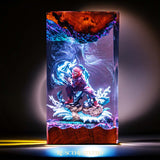
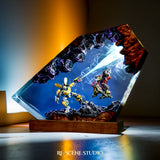
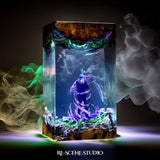
For fans who want to celebrate the Persona aesthetic in their space, handcrafted art captures the supernatural energy of the franchise in ways that mass-produced posters can't match.

The Soundtrack: Style You Can Hear
No discussion of Persona 5 is complete without mentioning Shoji Meguro's soundtrack. "Last Surprise," the standard battle theme, has over 200 million streams across platforms. It's acid jazz meets rock, with vocals that somehow make turn-based combat feel like a heist movie. "Beneath the Mask," the evening exploration theme, is one of the most calming pieces in gaming history. "Rivers in the Desert," the climactic boss theme, hits like a full concert.
The soundtrack isn't just good background music. It actively defines the game's identity. Persona 5 uses music the way films use cinematography: to set tone, pace scenes, and build emotional weight. This is why fans listen to the OST outside of the game. It works as standalone music because it was composed with that intention.
The Confidant System: Relationships That Matter
Beyond the Metaverse battles, Persona 5's Confidant system (the social simulation layer) is what gives the game its emotional core. Joker builds relationships with 21 different characters across Tokyo: a disgraced doctor running an underground clinic, a washed-up politician trying to redeem himself, a shut-in hacker who can't leave her room, and more.
Each Confidant arc tells a self-contained story about someone dealing with societal pressure, corruption, or personal failure. As you deepen these relationships, you unlock gameplay bonuses (new Persona fusion options, party abilities, shop discounts). But the real reward is the storytelling. The best Confidant arcs in Persona 5, particularly Futaba, Sojiro, and Yoshida, are better-written than many entire games.
This blend of social simulation and dungeon combat is what separates Persona from every other JRPG. You don't just fight your way through the story. You LIVE in the story, managing time between school, friendships, part-time jobs, and phantom thievery. The ticking calendar creates natural tension: there's never enough time to do everything, which forces meaningful choices.
Should You Play Persona 5 in 2026?
Absolutely. Persona 5 Royal is available on PlayStation, PC (Steam), Xbox, and Nintendo Switch. The Royal version includes an additional semester of content, new characters, and quality-of-life improvements that make it the definitive edition. A first playthrough typically takes 80 to 120 hours, which makes it one of the most content-rich single-player games available.
If you're new to the series, Persona 5 Royal is the best starting point. Each Persona game tells a standalone story with different characters, so no prior knowledge is needed. And if you've already played P5R and want more, the upcoming Persona 6 was confirmed with a teaser that suggests it will carry forward the series' signature style. For more deep-dives into gaming characters, check out our analysis of why Sephiroth is gaming's greatest villain.
For those who want to see other gaming franchises we've covered, our posts on Elden Ring lore and why Kratos captivates gamers explore similar questions about what makes gaming characters endure.
Frequently Asked Questions
Related Reading
Want to see what we make? Browse the Persona collection.
Featured Resin Lamps
Handcrafted with care — each one unique


Every lamp we create carries a piece of our heart — a small universe of light, resin, and imagination, handcrafted in our workshop for someone across the world who shares our love for these stories.