






Forest Inspired Home Decor: Biophilic Design for Small Spaces

You have seen the photos. A sunlit bedroom with pine branches across the headboard. A reading nook tucked into mossy greens and warm wood. A desk covered in ferns and a tiny glass terrarium.
Forest inspired home decor is the most popular variant of biophilic design, and the look, and forest inspired home decor is the most popular version of it. The catch is that almost every example you scroll past lives in a house with eighteen foot ceilings, a skylight, and three hundred square feet of free floor space. That is not most people.
Most people live in apartments, studios, townhouses, or bedrooms that are already doing three other jobs. Forest-inspired home decor in a small space is a completely different problem than forest inspired home decor in a cabin. If you try to recreate the Pinterest version in a real studio, you end up with a crowded room full of plants that will not survive your work schedule. The goal is to get the feeling of a forest without the physical footprint.
This guide walks through the five sensory cues the brain reads as "forest," how to hit each one in a small space without overcrowding the room, and what to skip entirely. By the end of this forest inspired home decor guide you will know how to turn any room into a version of the woods that actually fits inside the four walls you already have.
The Five Cues Your Brain Reads as "Forest"
Biophilic design research has looked at what specific sensory inputs make humans feel like they are in a natural environment. For forest specifically, five cues do most of the work. Hit three of them in a room and the room starts to read as a forest even if there is not a single living tree in sight.
- Organic textures like wood grain, moss, stone, linen, and rough weaves
- Deep green and earth tones in the 40 to 60 percent visible surface range
- Soft dappled light similar to sunlight filtering through leaves
- Low, warm ambient glow at eye level or below, mimicking canopy shade
- A focal point of layered depth that your eye can travel into
Notice how none of these require actual plants. Plants help, but they are not the load-bearing element. A room can feel like a forest with wood floors, linen curtains, green walls, a warm table lamp, and a single layered focal point. A room can also have twenty potted plants and still feel like a generic living room if the other cues are missing.
The cues matter more than the inventory.

Cue 1: Organic Textures (The Cheapest Fix)
Texture is the biggest visual cue and almost free to add. A linen throw over an armchair, a woven rattan basket on the floor, a small wooden tray on the nightstand, or a stone coaster on the desk all register as "natural" in a way that plastic and metal do not. Swapping out one synthetic item for one natural texture item is often the single change that tips a small room from "generic" to "forest inspired."
The trick in a small space is concentration, not spread. Pick three or four contact points in the room (the floor, a surface, a seating area, a corner) and add one natural texture to each. Do not spread texture across twenty locations. Your eye needs to rest on each one long enough to register it.
A single warm wooden surface with one linen piece on it reads louder than ten small wood accents scattered around the room.
Cue 2: Deep Green and Earth Tones
Color is the second biggest lever. For forest mood, you want deep greens (evergreen, fern, moss), warm browns (oak, walnut, terracotta), and muted creams (linen, unbleached cotton). The specific shade matters less than the temperature. Cool clinical whites and bright saturated primaries break the forest feeling instantly.
Warm earth tones reinforce it.

In a small space you do not need to paint the walls. A deep green throw pillow, a forest green throw blanket, or a single piece of dark green decor on a shelf is enough to anchor the color story. If you can swap one piece of bright colored decor for one piece of earth toned decor per week for a month, the room will shift on its own without ever feeling like a renovation.
Cue 3: Soft Dappled Light
Real forests have very specific light. It is not bright, it is not dark, it is dappled. Patches of warm sunlight break through the canopy and fall unevenly on the ground. Recreating this in a small space is easier than it sounds.
A sheer linen curtain over a window turns direct sunlight into soft, filtered, forest-like light within seconds. A woven paper lampshade does the same job for artificial light sources.
If you have heavy drapes or blackout curtains on a window you actually want to let light through, swap them for a sheer linen panel. This is the single biggest visual change you can make to a small room with zero furniture movement. The quality of the light across the whole space shifts immediately. If the window faces a busy street, layer the sheer behind a heavier curtain and only close the heavy one at night.
Cue 4: Low, Warm Ambient Glow
Evening light under a forest canopy is warm, low, and diffused. Not bright overhead daylight, not harsh white ceiling fixtures. This is where artificial lighting does the heavy lifting. A low accent light with a warm glow in the 2,200K to 2,700K range is closer to evening sunlight filtering through leaves than any overhead fixture will ever be. We walked through the biology of this in our guide to the 5 lighting mistakes that make any room look cheap, and the ceiling light habit is the first one to break for forest inspired design.

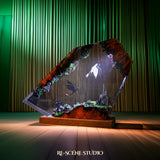
Small resin accent pieces work especially well here because the light comes from inside the body of the piece rather than from an exposed bulb, which is closer to how light actually behaves in nature. You see the glow, not the source. This is the same reason fireplaces feel more relaxing than overhead lights, and why candles feel more intimate than fluorescents. Diffused low warm light is the forest floor at dusk, recreated.

Cue 5: A Focal Point With Layered Depth
A forest is visually deep. You can look at a patch of woods and your eye keeps finding more details the longer you look: layered branches, moss on bark, light coming through leaves, a small animal movement. A room with forest mood needs at least one focal point that invites the same kind of extended looking. Flat decor does not.
A single poster, a wall mirror, or a plain rectangle of art does not give the eye anywhere to travel.

A layered focal point can be many things. A terrarium with moss and small branches. A shadow box with pressed leaves. A stacked arrangement of wooden frames with photos of the woods.
A resin piece with an embedded miniature forest scene. What they share is three-dimensional depth: your eye can travel into the object, not just across its surface. Small spaces benefit the most from these because one small focal point does more work than ten flat decorations.

Putting It Together in a Studio Apartment
Here is what the whole thing looks like in a real 400 square foot studio. One linen sheer curtain over the main window. One deep green throw blanket on the bed or couch. A small wooden tray or cutting board on the nightstand or desk.
A single warm accent lamp at low height, under 3,000K, diffused. A single layered focal point somewhere in the main sightline. That is five changes, two of which cost under twenty dollars and three of which can be handled in a single afternoon.

Do not spread the changes across the whole apartment. Concentrate them in the one area you spend the most time (usually the bed or the main seating area). A small studio with one forest-mood corner feels more like a forest than a whole apartment with scattered nature decor across every surface. The brain reads unified cues stronger than scattered ones.
For more forest inspired home decor ideas on how to keep the rest of the apartment coherent without overcrowding it, our guide to making any room feel cozy on a budget covers the same concentration-over-spread principle in more detail.
What to Skip
A few things get recommended in forest inspired decor guides that rarely work in small spaces. Fake preserved moss walls collect dust and look cheap up close. Large plastic tree branches or artificial foliage almost always read as artificial, which breaks the cue. Tree stump side tables take up too much floor space for the mood they deliver.
Wallpaper with photo-realistic forest scenes tends to feel like a backdrop on camera and busy in person. None of these are wrong exactly, but in small spaces they rarely earn their square footage.
Real plants are great if you have the light and the habit, and tragic if you do not. A single healthy pothos or fern does more for forest mood than six struggling half-dead plants ever will. Be honest about whether you actually water things before buying more than one.
Quick Reference: The Small Space Checklist
| Cue | Small Space Fix | Cost Range | Impact |
|---|---|---|---|
| Organic texture | Linen throw, woven basket, wooden tray | $15 to $60 | High |
| Earth tone color | Green throw pillow or blanket | $15 to $50 | High |
| Dappled light | Sheer linen window panel | $20 to $60 | Very high |
| Warm ambient glow | Warm 2,700K accent lamp or bulb swap | $10 to $80 | Very high |
| Layered focal point | Terrarium, shadow box, or resin diorama | $30 to $120 | High |
Total cost for a complete small space forest mood setup: usually between $90 and $200, depending on what you already own. Most of the impact comes from the first two or three changes. You do not need all five on day one.
Frequently Asked Questions
Featured Resin Lamps
Handcrafted with care, each one unique


Every lamp we create carries a piece of our heart: a small universe of light, resin, and imagination, handcrafted in our workshop for someone across the world who shares our love for these stories.